
Hannes Koenig (Sunset on the Isle of Sky)
Previous Lesson
Next Lesson
Author: Stephen Weller
2,093 words, 11 minutes read time
Cost of Following Jesus
Scripture Reference: Luke 9:57-62; Matthew 8:19-22
Context:
This passage occurs during a significant turning point in Jesus’ ministry. In Luke’s Gospel, Jesus has just “set His face to go to Jerusalem” (Luke 9:51), signaling His determined journey toward the cross, where He would accomplish God’s plan of redemption. As Jesus travels, large crowds continue to follow Him, attracted by His miracles, teaching, and growing reputation. However, Jesus consistently seeks to distinguish genuine discipleship from superficial enthusiasm. In this setting, several individuals express a desire to follow Him, yet Jesus responds by revealing the true cost of discipleship. To the eager scribe who promises to follow wherever He goes, Jesus explains that the Son of Man has no permanent earthly home, emphasizing that following Him may require surrendering comfort, security, and personal ambitions. To another whom Jesus calls directly, the man requests permission to first bury his father, but Jesus stresses the urgency of God’s kingdom, teaching that obedience to His call must take precedence over even the most important family responsibilities. A third individual wishes to follow Christ but first wants to say farewell to his family. Jesus responds with the illustration of a person plowing a field who looks back and cannot maintain a straight course, demonstrating that discipleship requires undivided commitment and perseverance. These encounters do not diminish the importance of family or proper responsibilities; rather, they reveal that allegiance to Christ must be supreme above all earthly relationships, obligations, and possessions. Together, Luke 9:57–62 and Matthew 8:19–22 challenge believers to examine the sincerity of their commitment to Christ and remind them that true discipleship involves wholehearted devotion, immediate obedience, and a willingness to place the kingdom of God above every competing priority.
Event Narrative:
The narrative for this section was obtained from two similar texts, using the highlighted material shown below. The selection was determined by Jerry Peyton and copyrighted in 2015 by Jerry Peyton and Biblical Studies Press L.L.C.
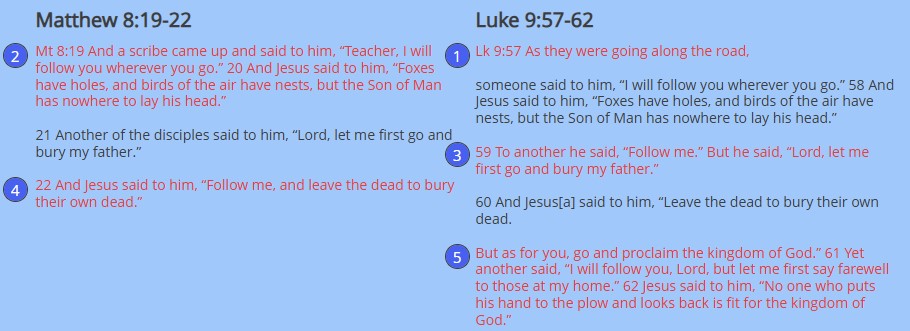
From the above worksheet photo, following the numbers and the text in red, the following narrative is produced.
Lk 9:57 As they were going along the road, Mt 8:19 a scribe came up and said to him, “Teacher, I will follow you wherever you go.”
20 And Jesus said to him, “Foxes have holes, and birds of the air have nests, but the Son of Man has nowhere to lay his head.”
Lk 9:59 To another [Jesus] said, “Follow me.”
But he said, “Lord, let me first go and bury my father.”
Mt 8:22 And Jesus said to him, “Follow me, and leave the dead to bury their own dead.” Lk 9:60 But as for you, go and proclaim the kingdom of God.”
61 Yet another said, “I will follow you, Lord, but let me first say farewell to those at my home.” 62 Jesus said to him, “No one who puts his hand to the plow and looks back is fit for the kingdom of God.”
Bible Lessons for this event:
H420 Will You Follow Jesus? (Matthew 8:19-20; Luke 9:57)
H421 Where Are You Looking When Plowing? (Matthew 8:22; Luke 9:59-62)
Event Summary:
This event addresses the cost of following Jesus. Through encounters with prospective disciples, Jesus highlights the challenges, sacrifices, and priorities required for true discipleship. The focus is on wholehearted commitment, prioritizing God’s kingdom, and the urgency of following Jesus.
Key points of this event are:
(1) Discipleship Requires Sacrifice (Luke 9:57-58; Matthew 8:19-20):
A scribe comes up to Jesus and said to him, “Teacher, I will follow you wherever you go,” but Jesus responds, “Foxes have holes, and birds of the air have nests, but the Son of Man has nowhere to lay his head.” The point Jesus is making is: following him involves a willingness to give up comfort and security. Discipleship is not about earthly stability but about trusting in God’s provision and prioritizing his mission.
(2) Prioritizing God’s Kingdom Over Personal Obligations (Luke 9:59-60; Matthew 8:21-22):
Another man comes to Jesus and expresses a desire to follow him but asks to first go and bury his father. Jesus replied, “Leave the dead to bury their own dead” and “go and proclaim the kingdom of God.” The point Jesus is making here is: Discipleship requires placing God’s kingdom above all other obligations. While honoring family is important, it must not take precedence over the urgency of following Jesus and proclaiming his message.
(3) Avoid Divided Loyalties (Luke 9:61-62):
Yet another one said, “I will follow you, Lord, but let me first say farewell to those at my home.” Jesus said to him, “No one who puts his hand to the plow and looks back is fit for the kingdom of God.” The point Jesus is making is: Discipleship demands complete focus and commitment. Divided loyalties or hesitation can hinder one’s ability to serve God wholeheartedly.
This event challenges believers to count the cost of discipleship and commit wholeheartedly to following Jesus. True discipleship requires sacrificing personal comfort, prioritizing God’s kingdom above all else, and maintaining an unwavering focus on his mission. These teachings remind Christians to embrace the urgency of their calling and to trust in Jesus as they follow him with faith and determination.
Discussion Questions with Extended Answers:
Luke 9:57–62; Matthew 8:19–22
1. What prompted the conversation between Jesus and the men described in these passages?
Answer:
As Jesus was traveling toward Jerusalem, several individuals expressed interest in following Him. One man enthusiastically declared, “Lord, I will follow You wherever You go.” Another was personally called by Jesus with the words, “Follow Me.” A third desired to follow Christ but requested time to say goodbye to his family first. These encounters provided Jesus with an opportunity to teach about the true cost of discipleship. Rather than encouraging shallow enthusiasm, Jesus revealed the sacrifices, priorities, and commitments required of those who would follow Him faithfully.
2. Why did Jesus respond by saying, “Foxes have holes, and birds of the air have nests, but the Son of Man has nowhere to lay His head”?
Answer:
Jesus was warning the first man that following Him involved hardship and sacrifice. Many people were attracted to Jesus because of His miracles, popularity, or teaching, but they did not fully understand the demands of discipleship. Jesus wanted this man to know that He did not offer earthly comfort, wealth, or security. Unlike animals that have places of shelter, Jesus lived a life of humility and often lacked permanent earthly accommodations. True disciples must be willing to follow Christ regardless of personal inconvenience or material loss. Jesus was testing whether the man’s commitment was based on genuine devotion or merely emotional enthusiasm.
3. What does the title “Son of Man” reveal about Jesus?
Answer:
“Son of Man” was Jesus’ favorite title for Himself and carries both humility and authority. It emphasizes His identification with humanity while also pointing to the prophecy of Daniel 7:13–14, where the Son of Man receives everlasting dominion and a kingdom from God. In this context, Jesus highlights His humble earthly condition, showing that the promised Messiah was not living in royal luxury but walking a path of suffering and service. The title reminds believers that Jesus fully entered the human experience while remaining the divine Messiah.
4. Why did the second man ask permission to bury his father before following Jesus?
Answer:
The request appears reasonable and respectful because honoring one’s parents was an important biblical duty. However, many scholars believe the man’s father had not yet died. The phrase likely meant, “Let me remain at home until my father dies and then I will follow You.” In other words, the man wanted to postpone obedience until a future, more convenient time. Jesus recognized that the request represented a delay rather than immediate commitment. The issue was not honoring family but placing other obligations ahead of obedience to Christ.
5. What did Jesus mean when He said, “Let the dead bury their own dead”?
Answer:
Jesus was using the word “dead” in two different senses. The physically dead can be buried by those who are spiritually dead—people who are not actively engaged in the kingdom of God. Jesus was emphasizing the urgency of His mission and the priority of proclaiming the gospel. He was not teaching disrespect for parents or neglect of family responsibilities. Rather, He was declaring that the call of God’s kingdom is so important that it must take precedence over every other obligation. Spiritual matters are eternal, and therefore they require immediate attention.
6. Why did Jesus tell the man, “Go and preach the kingdom of God”?
Answer:
Jesus was highlighting the importance and urgency of kingdom work. The gospel message concerns eternal life and the salvation of souls. While many responsibilities in life are important, none are as significant as participating in God’s redemptive purposes. By commanding the man to preach the kingdom, Jesus showed that following Him involves active service, not merely personal belief. Disciples are called to share God’s truth and help others come to faith in Christ.
7. Why did Jesus object when the third man wanted to say goodbye to his family?
Answer:
Jesus was not condemning family affection or proper farewells. In fact, the prophet Elisha was allowed to kiss his parents goodbye when called by Elijah (1 Kings 19:19–21). The issue was the condition of the man’s heart. His request revealed hesitation and divided loyalties. Jesus recognized that the man was looking backward rather than forward. A disciple must have a wholehearted commitment to Christ. When obedience is constantly delayed by competing priorities, discipleship becomes compromised.
8. What is the meaning of Jesus’ statement about putting one’s hand to the plow and not looking back?
Answer:
In ancient farming, a plowman had to keep his eyes fixed ahead to produce straight furrows. Looking backward would cause the plow to wander off course and ruin the field. Jesus used this image to illustrate the need for focused and unwavering commitment. A disciple cannot successfully follow Christ while continually longing for a former way of life or being distracted by competing loyalties. Effective discipleship requires perseverance, determination, and forward-looking faith.
9. What does Jesus mean when He says such a person is “not fit for the kingdom of God”?
Answer:
Jesus is describing a person whose divided commitment prevents effective service in God’s kingdom. The phrase does not teach salvation by works or perfection. Rather, it emphasizes that kingdom service requires wholehearted devotion. Someone who continually hesitates, delays, or looks back demonstrates that Christ is not truly first in his life. Jesus calls His followers to a level of commitment that places Him above every earthly relationship, ambition, and comfort.
10. What do these three encounters teach about the cost of discipleship?
Answer:
Together these encounters reveal three major challenges to following Christ. The first man represents those attracted by enthusiasm but unprepared for sacrifice. The second represents those who delay obedience because of competing responsibilities. The third represents those whose hearts remain divided between Christ and other attachments. Jesus teaches that true discipleship requires sacrifice, immediate obedience, and unwavering commitment. Following Christ is not merely a decision made with words; it is a lifelong surrender in which Jesus becomes the highest priority.
11. How do these passages challenge believers today?
Answer:
These passages force believers to examine their own priorities and commitments. Many people admire Jesus, attend church, or express a desire to follow Him, yet struggle to place Him first. Some seek comfort more than obedience. Others delay serving God until a more convenient season of life. Still others remain attached to past habits, relationships, or ambitions. Jesus calls every believer to count the cost, surrender personal priorities, and follow Him wholeheartedly. The kingdom of God advances through disciples who are willing to obey immediately and remain faithful regardless of the sacrifices involved.
12. What is the central lesson of Luke 9:57–62 and Matthew 8:19–22?
Answer:
The central lesson is that Jesus demands wholehearted and immediate commitment from those who follow Him. Discipleship is not based on convenience, comfort, or partial devotion. It requires a willingness to sacrifice personal security, place Christ above all other priorities, obey without delay, and persevere without looking back. Jesus is worthy of complete allegiance because He is the Son of God, the Savior, and the King of God’s kingdom. Those who truly follow Him must be prepared to give Him first place in every area of life.


Leave a comment