
Hannes Koenig (Mountain View)
Previous Lesson
Next Lesson
Author: Stephen Weller
2,830 words, 15 minutes read time
Sending Out the 72
Scripture Reference: Matthew 10:16; Luke 10:1-11
Context:
Context for Matthew 10:16; Luke 10:1–11
These passages occur during a significant stage in Jesus’ earthly ministry when He begins expanding the work of proclaiming the kingdom of God beyond His own personal preaching and healing ministry. In Matthew 10, Jesus has just chosen and commissioned the twelve apostles, giving them authority over unclean spirits and power to heal diseases. He sends them specifically to “the lost sheep of the house of Israel” with the message that “the kingdom of heaven is at hand.” However, Jesus does not hide the reality that faithful service will bring opposition. In Matthew 10:16, He tells them, “Behold, I send you forth as sheep in the midst of wolves: be ye therefore wise as serpents, and harmless as doves.” This statement introduces a larger discourse about persecution, rejection, and the cost of discipleship. The apostles were to depend upon God’s protection while exercising godly wisdom, avoiding unnecessary conflict yet never compromising truth. Their character was to combine discernment with innocence, courage with gentleness, reflecting the very nature of Christ Himself.
Luke 10:1–11 records a related but larger mission, in which Jesus appoints seventy (or seventy-two, depending on the manuscript tradition) additional disciples and sends them out in pairs ahead of Him to every city and place He intends to visit. This mission demonstrates that the work of the kingdom was not limited to the twelve apostles but was to be shared by many faithful laborers. Jesus begins by declaring that “the harvest truly is great, but the labourers are few,” emphasizing the urgency of the gospel mission and the need for God to raise up workers. Like the twelve, these disciples are sent with dependence upon God’s provision, carrying neither purse nor extra supplies, trusting that those who receive the message will provide for their needs. They are instructed to bring peace to receptive homes, remain content with what is provided, heal the sick, and proclaim that “the kingdom of God is come near unto you.” At the same time, they are warned that not every town will welcome them. If rejected, they are to shake the dust from their feet as a testimony against that city, symbolizing that those who reject God’s messengers also reject God’s offer of salvation.
Together, Matthew 10:16 and Luke 10:1–11 reveal important principles of Christian ministry that continue throughout the New Testament. Believers are called to proclaim the gospel in a hostile world, depending completely upon God’s provision and guidance. They must balance wisdom with purity, boldness with humility, and perseverance with trust in God’s sovereign plan. These passages also anticipate the future mission of the church after Christ’s resurrection, when the gospel would spread from Jerusalem to the ends of the earth despite persecution and opposition. Ultimately, they remind believers that the success of God’s kingdom does not depend upon human strength but upon faithful obedience to the One who sends His servants into the harvest.
Event Narrative:
The narrative for this section was obtained from two similar texts, using the highlighted material shown below. The selection was determined by Jerry Peyton and copyrighted in 2015 by Jerry Peyton and Biblical Studies Press L.L.C.
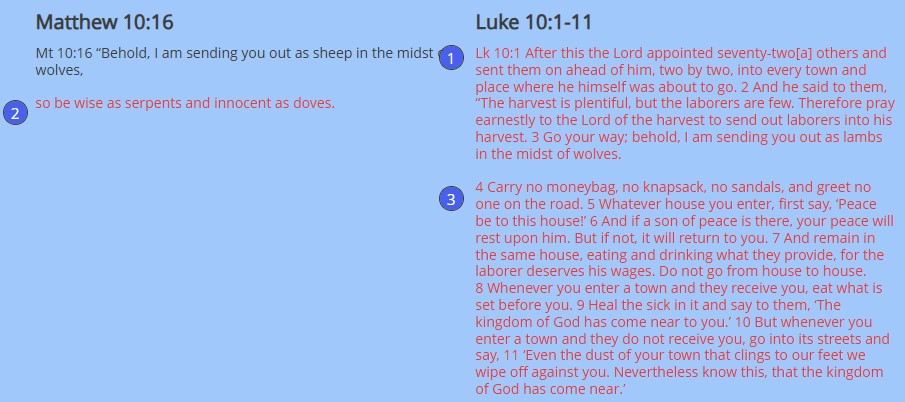
From the above worksheet photo, following the numbers and the text in red, the following narrative is produced.
Lk 10:1 After this the Lord appointed seventy-two others and sent them on ahead of him, two by two, into every town and place where he himself was about to go. 2 And he said to them, “The harvest is plentiful, but the laborers are few. Therefore, pray earnestly to the Lord of the harvest to send out laborers into his harvest. 3 Go your way; behold, I am sending you out as lambs in the midst of wolves, Mt 10:16 so be wise as serpents and innocent as doves.”
Lk 10:4 “Carry no moneybag, no knapsack, no sandals, and greet no one on the road. 5 Whatever house you enter, first say, ‘Peace be to this house!’ 6 And if a son of peace is there, your peace will rest upon him. But if not, it will return to you. 7 And remain in the same house, eating and drinking what they provide, for the laborer deserves his wages. Do not go from house to house.”
Lk 10:8 “Whenever you enter a town and they receive you, eat what is set before you. 9 Heal the sick in it and say to them, ‘The kingdom of God has come near to you.’ 10 But whenever you enter a town and they do not receive you, go into its streets and say, 11 ‘Even the dust of your town that clings to our feet we wipe off against you. Nevertheless, know this, that the kingdom of God has come near.’”
Bible Lessons for this event:
H423 Lambs in the Midst of Wolves (Matthew 10:16; Luke 10:1-3)
H424 Instructions for Those Being Sent Out (Luke 10:4-11)
Event Summary:
This event focuses on Jesus’ instructions to his disciples as he sends them out on a mission to proclaim the kingdom of God. They emphasize wisdom, reliance on God, urgency in the mission, and the call to trust in God’s provision and protection.
Key points of this event are:
(1) The Nature of the Mission (Matthew 10:16; Luke 10:1-3):
Jesus selects seventy-two men and sends them out ahead of him in twos into the towns where he was about to go. He said to them, “The harvest is plentiful, but the laborers are few. Therefore, pray earnestly to the Lord of the harvest to send out laborers into his harvest. Go your way; behold, I am sending you out as lambs in the midst of wolves, so be wise as serpents and innocent as doves.” The challenge is clear, the mission is urgent, requiring both wisdom (shrewdness) to navigate dangers and innocence to maintain integrity and reflect God’s love. Believers must rely on God for protection and strength as they face opposition.
(2) Dependence on God’s Provision (Luke 10:4-7):
“Carry no moneybag, no knapsack, no sandals,” and to accept hospitality from those who welcome them. The disciples are to trust God completely for their needs, demonstrating faith in his provision and relying on the hospitality of those who receive their message. This also emphasizes the simplicity and focus of their mission.
(3) Proclaiming the Kingdom of God (Luke 10:8-9):
Jesus instructs these disciples to “The mission of those being sent out is to “heal the sick and say to them, ‘The kingdom of God has come near to you.’’ The mission of these disciples is to demonstrate God’s power through healing and to declare the good news of His kingdom. Their work is both spiritual and practical, addressing physical and spiritual needs.
(4) Response to Rejection (Matthew 10:16; Luke 10:10-11):
Jesus warns them that not all will welcome them, and “whenever you enter a town and they do not receive you, go into its streets and say, ‘Even the dust of your town that clings to our feet we wipe off against you.” Not everyone will accept their message of the kingdom. The disciples are called to remain faithful and not be discouraged by rejection, leaving the outcome to God.
(5) The Urgency of the Mission (Luke 10:2):
This event opened with Jesus saying, “The harvest is plentiful, but the laborers are few.” There is, therefore, an urgent need for workers to share the good news. Believers are called to actively participate in and pray for the advancement of God’s kingdom.
This event teaches that following Jesus involves a challenging but rewarding mission. Believers are called to proclaim God’s kingdom with wisdom, humility, and reliance on his provision. The urgency of the mission requires faith, perseverance, and a focus on sharing the good news, even in the face of rejection. This passage encourages Christians to trust in God’s guidance and participate actively in advancing His kingdom.
Discussion Questions with Extended Answers:
Matthew 10:16; Luke 10:1–11
1. Why did Jesus compare His disciples to “sheep in the midst of wolves” (Matthew 10:16)?
Answer:
Jesus used this powerful image to prepare His followers for the reality that serving Him would often involve opposition. Sheep are naturally defenseless animals, while wolves are predators. The comparison teaches that the disciples would not spread the gospel through force or intimidation but through humble dependence upon God.
This warning was immediately relevant to the Twelve as they went throughout Israel, but it also describes the experience of believers throughout church history. Christians often find themselves in environments that are hostile to biblical truth. Rather than promising an easy path, Jesus honestly tells His followers that persecution, rejection, and hardship are part of faithful service.
Yet the illustration also highlights God’s care. Throughout Scripture, God is the Shepherd who watches over His flock (Psalm 23; John 10:11). The disciples were not abandoned among the wolves; they were sent under the protection and authority of the Good Shepherd.
2. What does Jesus mean when He says, “Be wise as serpents and harmless as doves”?
Answer:
Jesus combines two qualities that might seem opposite but are essential for effective ministry.
Being “wise as serpents” means exercising discernment, caution, and good judgment. The disciples were not to be naïve or reckless. They needed to understand the dangers around them, choose their words carefully, and avoid unnecessary conflict. Biblical wisdom recognizes the realities of a fallen world while seeking opportunities to advance God’s kingdom.
Being “harmless as doves” means maintaining purity, innocence, and integrity. The disciples were never to use deception, violence, or manipulation to accomplish God’s work. Their methods were to reflect the character of Christ Himself.
Together these qualities produce balanced Christian living. Believers are called to be intelligent without becoming cynical and gentle without becoming weak. The gospel messenger must possess both wisdom and holiness.
3. Why did Jesus send out seventy (or seventy-two) disciples in Luke 10:1?
Answer:
The sending of the seventy demonstrates that the mission of proclaiming God’s kingdom extended beyond the original Twelve Apostles. Jesus appointed additional followers to prepare the towns and villages for His own arrival.
Many scholars see symbolic significance in the number. The Table of Nations in Genesis 10 lists approximately seventy nations, representing the whole world. By sending seventy disciples, Jesus may have been illustrating that the message of salvation was ultimately intended for all peoples, not Israel alone.
This event also teaches an important principle about ministry: God’s work is too great for one person or one small group. Jesus intentionally multiplied workers, showing that every believer has a role in advancing the kingdom.
The mission of these disciples anticipates the Great Commission, where all followers of Christ are called to make disciples of all nations.
4. Why did Jesus say, “The harvest truly is great, but the laborers are few” (Luke 10:2)?
Answer:
Jesus viewed humanity as a field ready for harvest. Just as a farmer gathers ripe crops before they spoil, God desires people to respond to the gospel before the opportunity passes.
The problem was not the size of the harvest but the shortage of workers willing to participate. Many people needed to hear the good news, but relatively few were prepared to carry the message.
Jesus therefore instructed His disciples first to pray. Before they were sent into the field, they were to ask the “Lord of the harvest” to raise up more laborers. This reminds believers that evangelism is ultimately God’s work. He prepares hearts, opens doors, and calls workers into His service.
The verse remains highly relevant today. The world is filled with people searching for hope, truth, and forgiveness, and Christ continues to call His church to pray and participate in His harvest.
5. Why were the disciples instructed to travel lightly and not depend on their own provisions (Luke 10:4)?
Answer:
Jesus told the disciples not to carry extra money, supplies, or provisions because He wanted them to depend upon God’s care and the hospitality of those who received their message.
Their urgency reflected the importance of the mission. They were not embarking on a leisurely journey but were carrying the announcement that the kingdom of God had come near.
Depending on others also created opportunities for fellowship and demonstrated that those who benefited spiritually should willingly support those who minister to them. Later, Jesus would affirm that “the laborer is worthy of his wages” (Luke 10:7).
This instruction was specific to this mission and is not necessarily a universal command for all Christian travel. However, the underlying principle remains: God’s servants should trust Him to provide what they need while they faithfully carry out His work.
6. What was the significance of offering peace to a household (Luke 10:5-6)?
Answer:
The greeting, “Peace be to this house,” was much more than a polite expression. In Jewish thought, peace (shalom) represented wholeness, blessing, reconciliation, and God’s favor.
When the disciples entered a home, they announced that God’s kingdom and its blessings were available to those who would receive His Messiah. If the household welcomed the message, that peace would remain upon them. If they rejected it, the peace would return to the disciples.
This teaches that the gospel always requires a response. God’s offer of salvation is extended freely, but individuals must choose whether to receive or reject it.
The greeting also reveals the heart of Christian ministry. Believers are sent not to condemn but to offer reconciliation with God through Jesus Christ.
7. Why did Jesus tell the disciples to remain in one house and not move from place to place (Luke 10:7)?
Answer:
Jesus instructed the disciples to stay in the first welcoming home rather than seeking better accommodations because their focus was to be the ministry, not personal comfort.
Moving from house to house could give the appearance of selfishness or favoritism, as though they were searching for greater luxury or material benefit. Remaining in one place demonstrated contentment and sincerity.
This instruction also helped build deeper relationships with the family hosting them, allowing for more effective ministry and discipleship.
The principle encourages believers to serve with humility, gratitude, and simplicity, remembering that the message of Christ is far more important than personal convenience.
8. Why were the disciples told to heal the sick and proclaim that “the kingdom of God has come near” (Luke 10:9)?
Answer:
The miracles performed by the disciples served as visible evidence that God’s kingdom was breaking into the world through Jesus Christ.
Throughout the Old Testament, the coming Messianic age was associated with healing, restoration, and the defeat of evil. By healing the sick, the disciples demonstrated that Jesus was fulfilling those promises.
However, the miracles were never the central message. The primary proclamation was that God’s kingdom had come near through the person and work of Jesus. Physical healing pointed to the greater spiritual healing available through faith in Him.
Today, while miraculous healings still occur according to God’s will, the central mission of the church remains proclaiming the gospel of Christ, through whom people receive forgiveness and eternal life.
9. Why were the disciples instructed to shake the dust off their feet if a town rejected them (Luke 10:10-11)?
Answer:
Shaking the dust from their feet was a symbolic act that declared the disciples were no longer responsible for the town’s rejection of God’s message.
Faithful Jews sometimes shook Gentile dust from their sandals when returning to Israel as a sign of separation. Jesus adapted this practice to show that rejecting the gospel placed a community outside the blessings being offered.
Importantly, this action was not an expression of personal anger or revenge. Even while shaking off the dust, the disciples were to proclaim, “The kingdom of God has come near.” The opportunity for repentance had been presented, and the responsibility for the response rested with the hearers.
This teaches believers that they are responsible for faithfully sharing the gospel, but they cannot force others to accept it.
10. What overall lesson do Matthew 10:16 and Luke 10:1-11 teach about Christian ministry?
Answer:
Together, these passages present a balanced picture of Christian service. Believers are sent into a world that may oppose them, yet they go under the authority and protection of Christ.
They are to serve with wisdom and innocence, courage and humility. They must trust God for provision, focus on the message rather than personal gain, and offer peace and salvation through the gospel.
The mission is urgent because the harvest is plentiful, and every believer is called to participate by praying, serving, giving, or proclaiming God’s truth.
Ultimately, these passages remind Christians that success is measured not by universal acceptance but by faithful obedience. The disciples were sent to announce that the kingdom of God had come near through Jesus Christ, and that remains the central mission of the church today.


Leave a comment