
Previous Lesson
Next Lesson
Author: Stephen Weller
2,298 words, 12 minutes read time
Return of the 72
Scripture Reference: Matthew 11:25-27; Luke 10:17-22
Context:
These parallel passages occur during a significant turning point in Jesus’ earthly ministry. Just before this event, Jesus had denounced the Galilean cities of Chorazin, Bethsaida, and Capernaum because they had witnessed His miracles yet refused to repent (Matthew 11:20–24; Luke 10:13–16). At the same time, Jesus had sent out seventy (or seventy-two) disciples to preach the kingdom of God, heal the sick, and proclaim that God’s reign had come near. They returned filled with joy, reporting that even the demons had submitted to them through His name (Luke 10:17). Jesus responded by declaring that He had seen Satan’s downfall and that He had given His followers authority over the power of the enemy. Yet He redirected their focus away from miraculous power and toward the greater blessing that their names were written in heaven. It was at this very moment of victory, following both widespread rejection by the proud and the joyful faith of His humble disciples, that Jesus broke forth into a prayer of thanksgiving to the Father. He praised God because divine truth had been hidden from the “wise and learned”—those who trusted in their own understanding and religious status—and graciously revealed to “little children,” those who approached God with humility and dependence. Jesus then made one of the clearest declarations of His unique relationship with the Father, affirming that all authority had been entrusted to Him and that no one truly knows the Father except through the Son, nor the Son except through the Father and those to whom the Son chooses to reveal Him. This passage highlights both the sovereignty of God in revealing truth and the exclusive role of Jesus Christ as the mediator of that revelation. It serves as a bridge between the rejection of the unbelieving crowds and the gracious invitation that follows in Matthew’s Gospel: “Come unto me, all ye that labour and are heavy laden, and I will give you rest” (Matthew 11:28). Together, these verses emphasize that entrance into the kingdom is not gained through human wisdom or achievement, but through humble faith and the gracious revelation of God through His Son.
Event Narrative:
The narrative for this section was obtained from two similar texts, using the highlighted material shown below. The selection was determined by Jerry Peyton and copyrighted in 2015 by Jerry Peyton and Biblical Studies Press L.L.C.
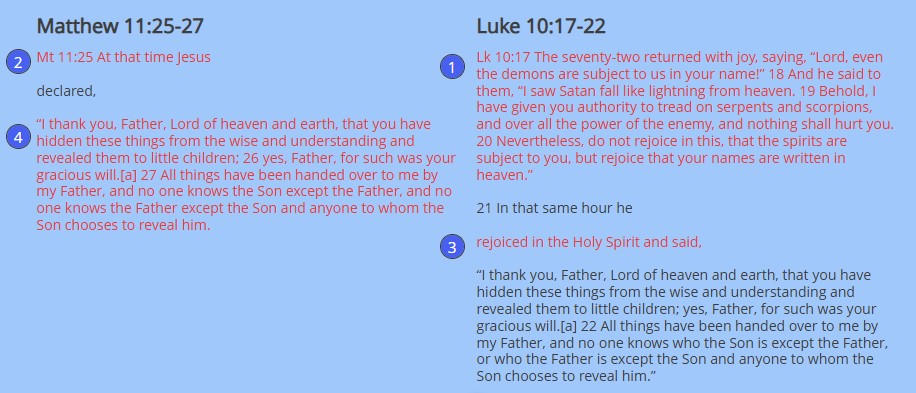
From the above worksheet photo, following the numbers and the text in red, the following narrative is produced.
Lk 10:17 The seventy-two returned with joy, saying, “Lord, even the demons are subject to us in your name!”
Lk 10:18 And he said to them, “I saw Satan fall like lightning from heaven. 19 Behold, I have given you authority to tread on serpents and scorpions, and over all the power of the enemy, and nothing shall hurt you. 20 Nevertheless, do not rejoice in this, that the spirits are subject to you, but rejoice that your names are written in heaven.”
Mt 11:25 At that time Jesus Lk 10:21 rejoiced in the Holy Spirit and said, Mt 11:25 “I thank you, Father, Lord of heaven and earth, that you have hidden these things from the wise and understanding and revealed them to little children; 26 yes, Father, for such was your gracious will. 27 All things have been handed over to me by my Father, and no one knows the Son except the Father, and no one knows the Father except the Son and anyone to whom the Son chooses to reveal him.”
Bible Lessons for this event:
H426 Return of the 72 With Joy (Luke 10:17-20)
H427 A Unique Relationship (Matthew 11:25-27; Luke 10:21
Event Summary:
This event highlights Jesus’ prayer of thanksgiving and his teaching about the revelation of God’s truth to the humble. They emphasize themes of God’s sovereignty, the importance of humility, the unique relationship between the Father and the Son, and the joy of participating in God’s kingdom.
Key points of this event are:
(1) Rejoicing in God’s Sovereignty and Revelation (Matthew 11:25-26; Luke 10:21):
We find Jesus rejoicing in the Holy Spirit (Luke 10:21), and saying, “I thank you, Father, Lord of heaven and earth, that you have hidden these things from the wise and understanding and revealed them to little children” (Matthew 11:25), and doing so was his “gracious will.” (Matthew 11:26) Only through humility and childlike faith does true understanding of God come. It does not come through human wisdom or pride. God chooses to reveal himself to those who depend on him.
(2) The Unique Relationship Between the Father and the Son (Matthew 11:27):
Jesus continues, and says, “All things have been handed over to me by my Father, and no one knows the Son except the Father, and no one knows the Father except the Son and anyone to whom the Son chooses to reveal him.” (Matthew 11:27) This makes Jesus the exclusive mediator between God and humanity. Only through Jesus can people truly know the Father. This underscores his divine authority and unique relationship with God.
(3) Joy in Participating in God’s Kingdom (Luke 10:17-20):
Going back to the beginning of the event, we find the disciples returning from their mission with great joy, reporting that even demons submitted to them in Jesus’ name. Jesus responds by affirming their spiritual authority but reminds them to rejoice not in their power but in their names being written in heaven. He makes it clear that the ultimate source of joy for believers is their salvation and relationship with God, not earthly power or accomplishments.
This event emphasizes the joy and privilege of knowing God through Jesus Christ. True understanding of God comes not through human wisdom but through humility and faith. Believers are encouraged to find their greatest joy in their salvation and relationship with God, trusting in his sovereignty and delighting in his plan of redemption.
Discussion Questions with Extended Answers:
Matthew 11:25–27; Luke 10:17–22
Lesson Theme: The Father Reveals His Truth Through the Son
1. Why did Jesus begin by thanking the Father in these passages?
Answer:
Jesus began by saying, “I thank You, Father, Lord of heaven and earth,” because He recognized that God’s sovereign plan was being perfectly accomplished. The seventy disciples had returned rejoicing over the authority Christ had given them, but Jesus directed their attention beyond their accomplishments to the wisdom and purpose of God.
The Father had chosen to reveal the truth of His kingdom not primarily through the religious elite, but through humble followers who trusted Him. This prayer reminds believers that God’s work is not dependent upon human wisdom, education, or status, but upon His gracious will.
Jesus’ thanksgiving also demonstrates the perfect unity between the Father and the Son. Rather than seeking His own glory, Jesus continually honored the Father and acknowledged His sovereign authority over all creation.
2. What does Jesus mean when He says that these things were hidden from the “wise and prudent” and revealed to “babes”?
Answer:
The “wise and prudent” refers primarily to those who trusted in their own understanding and religious knowledge. Many of the scribes and Pharisees possessed extensive biblical education, yet their pride prevented them from recognizing Jesus as the Messiah.
The “babes” are not necessarily children in age but people who approach God with humility, dependence, and faith. The disciples themselves were ordinary fishermen, tax collectors, and common laborers who simply believed and followed Christ.
This passage teaches that spiritual understanding is not earned through intellect alone. God graciously opens the hearts of those who come to Him with childlike faith. Pride often blinds a person to spiritual truth, while humility prepares the heart to receive God’s revelation.
James later echoes this principle by writing, “God resists the proud, but gives grace unto the humble” (James 4:6).
3. Why does Jesus call the Father “Lord of heaven and earth”?
Answer:
By calling God “Lord of heaven and earth,” Jesus emphasizes the Father’s absolute sovereignty over all creation. Everything that exists belongs to Him and operates according to His divine purpose.
The success of the disciples’ mission was not merely the result of their efforts but the outworking of God’s sovereign plan. Even the revelation of spiritual truth occurs according to God’s will.
This title also reminds believers that the One who governs the entire universe is personally involved in revealing Himself to those who seek Him. The Creator of heaven and earth chooses to make Himself known through His Son.
4. What is the significance of Jesus saying, “Even so, Father; for so it seemed good in Your sight”?
Answer:
This statement reveals Jesus’ complete submission to the Father’s will. Although many rejected Him, Jesus accepted that God’s plan was perfect and good.
Rather than questioning why the religious leaders remained blind, Jesus rejoiced that the Father was accomplishing His purposes exactly as He intended. This demonstrates the trust and harmony that exists within the Godhead.
For believers, this becomes a model of faith. There are times when God’s ways may not fully make sense to us, but we can trust that His wisdom is greater than ours and that His purposes are always righteous.
5. What does Jesus mean by saying, “All things are delivered unto Me of My Father”?
Answer:
Jesus is declaring the authority the Father has entrusted to Him. The Father has given the Son authority over salvation, judgment, revelation, and the establishment of God’s kingdom.
This statement points to Christ’s divine identity. He is not merely a prophet or teacher but the One through whom the Father carries out His redemptive work.
After His resurrection, Jesus would make a similar declaration: “All authority is given unto Me in heaven and in earth” (Matthew 28:18). His authority extends over every power, including Satan and his demons, which the seventy had just witnessed.
6. Why does Jesus say that no one truly knows the Son except the Father?
Answer:
Jesus is teaching that His nature and identity are infinitely deep and fully comprehended only by the Father. Human beings cannot discover the true identity of Christ merely through observation or intellectual effort.
Throughout His earthly ministry, many people saw His miracles, heard His teaching, and yet failed to understand who He truly was. Only through divine revelation can someone recognize Jesus as the Son of God and Savior of the world.
Peter’s confession illustrates this truth when Jesus told him, “Flesh and blood has not revealed this unto thee, but My Father which is in heaven” (Matthew 16:17).
7. Why does Jesus also say that no one knows the Father except the Son and those to whom the Son reveals Him?
Answer:
Jesus declares Himself to be the exclusive revealer of God. Humanity cannot come to a true knowledge of the Father apart from Christ.
Sin has separated mankind from God, making divine revelation necessary. Jesus came to reveal the Father’s character, holiness, love, mercy, and plan of salvation.
This truth is reinforced elsewhere in Scripture:
- “He that hath seen Me hath seen the Father” (John 14:9).
- “No man hath seen God at any time; the only begotten Son… He hath declared Him” (John 1:18).
Salvation, therefore, is not merely learning about God but coming to know Him personally through His Son.
8. How do these verses reveal the relationship between the Father and the Son?
Answer:
These verses provide one of the clearest pictures of the unique relationship between the Father and the Son. They demonstrate complete unity, mutual knowledge, shared authority, and perfect fellowship.
The Father entrusts all things to the Son. The Son perfectly knows the Father. The Son reveals the Father to humanity. Their relationship is unlike any other and reveals the divine nature of Christ.
This passage strongly supports the biblical doctrine of the Trinity, showing distinct persons who possess perfect unity of purpose and essence.
9. How does Luke’s account connect the disciples’ victory over demons with Jesus’ prayer of thanksgiving?
Answer:
The seventy disciples returned amazed that even demons obeyed them in Jesus’ name. Jesus acknowledged their victory but redirected their focus from power to relationship.
Immediately after speaking about Satan’s defeat and telling them to rejoice that their names were written in heaven, Jesus offered this prayer of thanksgiving. The true reason for joy was not miraculous power but the gracious revelation and salvation God had provided.
Their success in ministry was evidence that God’s kingdom was advancing and that the Father was revealing His truth through the Son.
The greatest blessing is not what believers accomplish for God, but that they belong to Him.
10. What practical lessons should believers learn from Matthew 11:25–27 and Luke 10:17–22?
Answer:
Several important lessons emerge from these passages:
- Humility is essential for spiritual understanding. God delights in revealing Himself to those who come with childlike faith.
- Salvation is entirely God’s gracious work. The Father reveals Himself through the Son according to His sovereign purpose.
- Jesus alone is the way to know God. There is no true knowledge of the Father apart from Christ.
- Our greatest joy is not ministry success but eternal salvation. The disciples were reminded to rejoice that their names were written in heaven.
- Believers can trust God’s wisdom even when His ways seem mysterious. Jesus Himself rested in the Father’s perfect will.
Ultimately, these verses call believers to abandon pride, trust completely in Christ, and rejoice that God has graciously revealed Himself through His Son. Through Jesus, ordinary people are invited into the eternal fellowship that exists between the Father and the Son; a privilege far greater than any earthly achievement.


Leave a comment