
Terri Waters Photography & Design (People enjoying the sun on the rocks at Piskies Cove near Cudden Point Cornwall with the Lizard Peninsula in the background. )
Previous Lesson
Next Lesson
Author: Stephen Weller
3,640 words, 19 minutes read time
Rebuking Hypocritical Religious Leaders
Scripture Reference: Matthew 23:4, 13-36; Luke 11:37-54
Context:
These passages record one of the strongest public confrontations between Jesus and the religious leaders of His day. During the final week before His crucifixion, Jesus openly exposed the hypocrisy of the scribes, Pharisees, and lawyers who were regarded by many as the spiritual authorities of Israel. Although they were entrusted with teaching God’s Law, they had gradually replaced genuine devotion to God with a system of traditions, regulations, and outward displays of righteousness. Jesus declared that they burdened the people with countless religious requirements while failing to help them carry those burdens or directing them toward the mercy and grace of God (Matthew 23:4). In Luke’s account, the confrontation begins when a Pharisee is surprised that Jesus does not follow the ceremonial handwashing tradition before a meal. Jesus uses the occasion to reveal that while the religious leaders carefully maintained external rituals, their hearts were filled with greed, pride, and self-interest. Their religion focused on appearances rather than true holiness, causing them to neglect justice, mercy, and the love of God.
The repeated “woes” pronounced by Jesus are not merely expressions of anger but solemn declarations of divine judgment. Jesus condemned these leaders because they shut people out of the kingdom of heaven by rejecting Him and discouraging others from believing in Him. They appeared righteous on the outside, but inwardly they were spiritually corrupt. They carefully tithed even the smallest herbs while neglecting the greater matters of the Law—justice, mercy, and faithfulness. Jesus compared them to whitewashed tombs, beautiful on the exterior but filled with death within, illustrating the contrast between their public image and their true spiritual condition. He also condemned them for honoring the prophets of the past while displaying the same rebellious spirit as their ancestors who persecuted and killed God’s messengers. By rejecting Jesus Himself, they were completing the long history of Israel’s resistance to God’s revelation.
These rebukes fit within Matthew’s broader presentation of Jesus as the promised Messiah who possesses full authority over Israel’s religious establishment. The confrontation also prepares the way for Jesus’ prophecy concerning Jerusalem’s coming judgment, which follows later in the chapter. The leaders’ rejection of Christ would ultimately result in devastating consequences for the nation, culminating in the destruction of Jerusalem in AD 70. At the same time, these passages serve as a timeless warning against religious hypocrisy. Jesus teaches that God is concerned not merely with outward obedience and public reputation but with a transformed heart marked by humility, faith, justice, mercy, and sincere devotion. The passages challenge every generation of believers to examine whether their faith is authentic and centered on God or merely an external form of religion that lacks true spiritual life.
Event Narrative:
The narrative for this section was obtained from two similar texts, using the highlighted material shown below. The selection was determined by Jerry Peyton and copyrighted in 2015 by Jerry Peyton and Biblical Studies Press L.L.C.
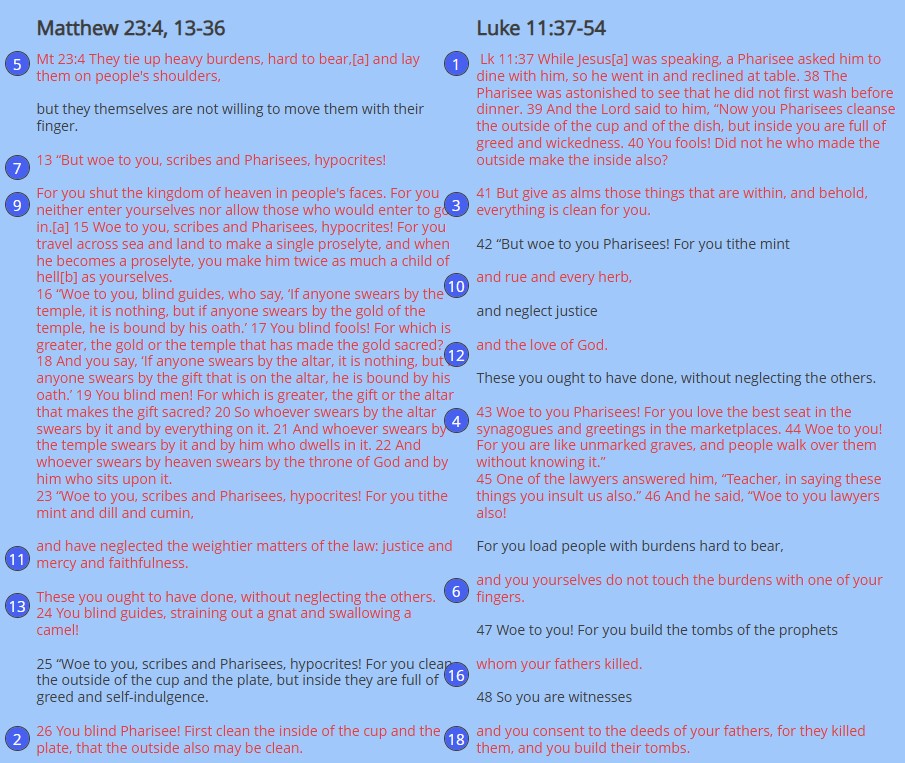
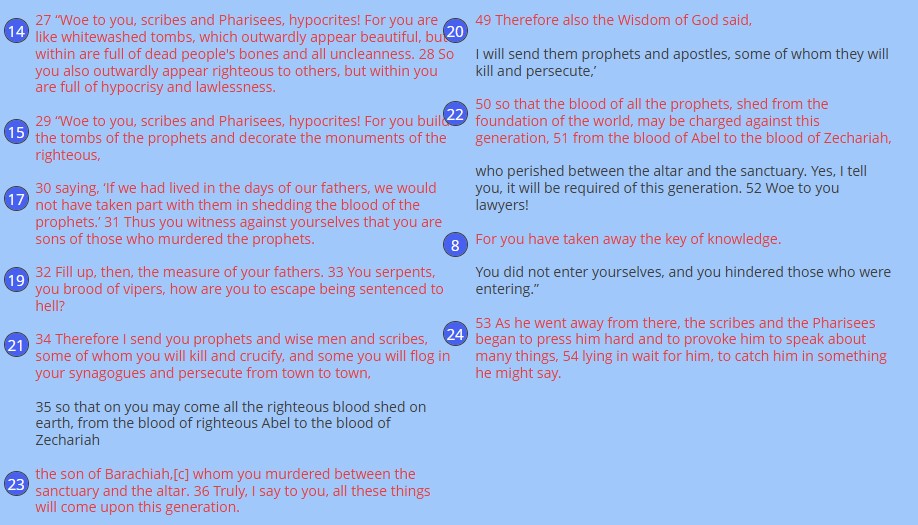
From the above worksheet photo, following the numbers and the text in red, the following narrative is produced.
Woes 1 – 5
Lk 11:37 While Jesus was speaking, a Pharisee asked him to dine with him, so he went in and reclined at table. 38 The Pharisee was astonished to see that he did not first wash before dinner. 39 And the Lord said to him, “Now you Pharisees cleanse the outside of the cup and of the dish, but inside you are full of greed and wickedness. 40 You fools! Did not he who made the outside make the inside also? Mt 23:26 You blind Pharisee! First clean the inside of the cup and the plate, so that the outside also may be clean. Lk 11:41 But give as alms those things that are within, and behold, everything is clean for you.”
Lk 11:43 “Woe to you Pharisees! For you love the best seat in the synagogues and greetings in the marketplaces. 44 Woe to you! For you are like unmarked graves, and people walk over them without knowing it.”
Lk 11:45 One of the lawyers answered him, “Teacher, in saying these things you insult us also.”
Lk 11:46 And [Jesus] said, “Woe to you lawyers also! Mt 23:4 They tie up heavy burdens, hard to bear, and lay them on people’s shoulders, Lk 11:46 and you yourselves do not touch the burdens with one of your fingers.”
Mt 23:13 “But woe to you, scribes and Pharisees, hypocrites! Lk 11:52 For you have taken away the key of knowledge. Mt 23:13 For you shut the kingdom of heaven in people’s faces. For you neither enter yourselves nor allow those who would enter to go in.”
Mt 23:15 “Woe to you, scribes and Pharisees, hypocrites! For you travel across sea and land to make a single proselyte, and when he becomes a proselyte, you make him twice as much a child of hell as yourselves.”
16 “Woe to you, blind guides, who say, ‘If anyone swears by the temple, it is nothing, but if anyone swears by the gold of the temple, he is bound by his oath.’ 17 You blind fools! For which is greater, the gold or the temple that has made the gold sacred? 18 And you say, ‘If anyone swears by the altar, it is nothing, but if anyone swears by the gift that is on the altar, he is bound by his oath.’ 19 You blind men! For which is greater, the gift or the altar that makes the gift sacred? 20 So whoever swears by the altar swears by it and by everything on it. 21 And whoever swears by the temple swears by it and by him who dwells in it. 22 And whoever swears by heaven swears by the throne of God and by him who sits upon it.”
Woes 6 – 8
23 “Woe to you, scribes and Pharisees, hypocrites! For you tithe mint and dill and cumin, Lk 11:42 and rue and every herb, Mt 23:23 and have neglected the weightier matters of the law: justice and mercy and faithfulness Lk 11:42 and the love of God. Mt 23:23 These you ought to have done, without neglecting the others. 24 You blind guides, straining out a gnat and swallowing a camel!”
Mt 23:27 “Woe to you, scribes and Pharisees, hypocrites! For you are like whitewashed tombs, which outwardly appear beautiful, but within are full of dead people’s bones and all uncleanness. 28 So you also outwardly appear righteous to others, but within you are full of hypocrisy and lawlessness.”
Mt 23:29 “Woe to you, scribes and Pharisees, hypocrites! For you build the tombs of the prophets and decorate the monuments of the righteous, Lk 11:47 whom your fathers killed. Mt 23:30 saying, ‘If we had lived in the days of our fathers, we would not have taken part with them in shedding the blood of the prophets.’ 31 Thus you witness against yourselves that you are sons of those who murdered the prophets Lk 11:48 and you consent to the deeds of your fathers, for they killed them, and you build their tombs. Mt 23:32 Fill up, then, the measure of your fathers. 33 You serpents, you brood of vipers, how are you to escape being sentenced to hell?”
Lk 11:49 “Therefore also the Wisdom of God said, Mt 23:34 I send you prophets and wise men and scribes, some of whom you will kill and crucify, and some you will flog in your synagogues and persecute from town to town Lk 11:50 so that the blood of all the prophets, shed from the foundation of the world, may be charged against this generation, 51 from the blood of Abel to the blood of Zechariah, Mt 23:35 the son of Barachiah, whom you murdered between the sanctuary and the altar. 36 Truly, I say to you, all these things will come upon this generation.”
Lk 11:53 As [Jesus] went away from there, the scribes and the Pharisees began to press him hard and to provoke him to speak about many things, 54 lying in wait for him, to catch him in something he might say.
Bible Lessons for this event:
H459 Strong Words at Dinner (Matthew 23:26; Luke 11:37-40)
H460 “Woe to You Pharisees!” (Luke 11:41, 43-45)
H461 “Who to You Lawyers!” (Matthew 23:4, 13, 15; Luke 11:46, 52)
H462 Swearing by the Temple and the Altar (Matthew 23:15-22)
H463 Wrong Focus (Matthew 23:23-24; Luke 11:42)
H464 Like Whitewashed Tombs (Matthew 23:27-28)
H465 You Brood of Vipers (Matthew 23:29-33; Luke 11:47-48)
H466 No Different than their Forefathers (Matthew 23:34-36; Luke 11:49-51, 53-54)
Event Summary:
This event contains Jesus’ sharp rebukes of the scribes and Pharisees, condemning their hypocrisy, legalism, and failure to reflect God’s love and justice. Jesus pronounces woes upon them for their actions, which burden others and distort God’s truth. The overarching message focuses on the need for humility, authenticity, and alignment with God’s will.
Key points of this event are:
(1) Burdening Others with Legalism:
- Jesus speaking about the lawyers, said, “They tie up heavy burdens, hard to bear, and lay them on people’s shoulders, and you yourselves do not touch the burdens with one of your fingers.” (Matthew 23:4) The Pharisees impose strict rules and rituals on others, but they fail to show compassion or help people carry these burdens. They prioritize external religiosity over inner transformation and fail to understand that true leadership involves guiding others with love and grace, not burdening them with oppressive legalism or empty traditions.
(2) Hypocrisy and Outward Appearances:
- The Pharisees are condemned by Jesus for focusing on outward appearances while neglecting inner righteousness. “[They] shut the kingdom of heaven in people’s faces. For [they] neither enter [themselves] nor allow those who would enter to go in.” (Matthew 23:14) “[They] cleanse the outside of the cup and of the dish, but inside [they] are full of greed and wickedness. You fools! Did not he who made the outside make the inside also?” (Luke 11:39-40) “[They] are like whitewashed tombs, which outwardly appear beautiful, but within are full of dead people’s bones and all uncleanness. So, [they] outwardly appear righteous to others, but within [they] are full of hypocrisy and lawlessness. (See Matthew 23:27-28). They fail to understand that true righteousness comes from a transformed heart, not from external appearances as God values integrity, not hypocrisy.
(3) Neglecting Justice, Mercy, and Faith:
- He refers to the scribes and Pharisees as “hypocrites! For [they] tithe mint and dill and cumin, (See Matthew 23:23) rue and every herb (See Luke 11:42) and have neglected the weightier matters of the law: justice and mercy and faithfulness. (See Matthew 23) They meticulously tithe small things like herbs but fail to uphold God’s higher priorities of justice, mercy, and faithfulness, failing to understand God’s true commands are rooted in love, justice, and compassion. Without these core virtues their rituals are meaningless.
(4) Opposition to God’s Prophets and Word:
- Jesus continues to rebuke the Pharisees, now for their complicity in rejecting and persecuting God’s prophets, even as they honor their tombs. He accuses them of following the same pattern as their ancestors who killed the prophets. (See Luke 11:48) By rejecting God’s messengers the Pharisees are ejecting God Himself. Leaders who resist God’s truth will bring judgment upon themselves and their generation.
(5) Hinderers of Knowledge:
- Jesus accused them of taking away the key of knowledge and shutting the door to the kingdom of heaven in people’s faces (See Luke 22:52; Matthew 23:13). God calls righteous leaders to guide people to God, not obstruct them as these Pharisees were doing. Misusing authority and distorting God’s truth leads to greater accountability.
(6) The Consequences of Hypocrisy:
- Because of the Pharisees hypocrisy and their rejection of God’s truth, Jesus warns them of severe judgment (See Matthew 23:33; Luke 11:50). Their hypocrisy and resistance to God’s truth will lead to their judgment. Leaders bear greater responsibility for their influence on others.
This event emphasizes the dangers of hypocrisy, legalism, and neglecting the heart of God’s law. Jesus calls out the religious leaders for burdening others, focusing on appearances, and rejecting God’s truth, warning of the severe judgment that follows. True discipleship requires humility, sincerity, and a life rooted in justice, mercy, and faithfulness. This event challenges all believers to examine their hearts and align their lives with God’s values.
Discussion Questions with Extended Answers:
Matthew 23:4, 13–36; Luke 11:37–54
1. What did Jesus mean when He said the religious leaders “tie up heavy burdens” and place them on others, but will not lift a finger to help them? (Matthew 23:4)
Answer:
Jesus was condemning the scribes and Pharisees for creating a religion that focused on rules, traditions, and external performance rather than on a genuine relationship with God. They added numerous regulations to God’s Law and expected others to follow them perfectly. These requirements became spiritual burdens that were difficult for ordinary people to bear. Yet the leaders themselves showed little compassion or concern for helping people understand God’s grace and mercy. Instead of guiding people toward God, they often increased guilt and discouragement. True spiritual leaders help people carry burdens, point them to God’s mercy, and lead them toward faith and obedience. Jesus Himself demonstrated this by inviting the weary and burdened to come to Him for rest.
2. Why did Jesus repeatedly pronounce “woe” upon the scribes and Pharisees? (Matthew 23:13–36; Luke 11:42–52)
Answer:
The word “woe” expresses sorrow, warning, and coming judgment. Jesus was not merely criticizing the religious leaders; He was announcing God’s judgment upon persistent hypocrisy and unbelief. These leaders possessed great spiritual knowledge and influence, yet they misused their position. They appeared righteous outwardly while their hearts remained far from God. Their actions misled others and hindered people from entering God’s kingdom. Jesus’ warnings revealed both His righteous anger against sin and His grief over their refusal to repent. The repeated woes demonstrate the seriousness of spiritual hypocrisy and the accountability that comes with spiritual leadership.
3. How were the religious leaders shutting the kingdom of heaven in people’s faces? (Matthew 23:13)
Answer:
The scribes and Pharisees were preventing people from entering God’s kingdom by rejecting Jesus and discouraging others from believing in Him. They possessed the Scriptures that pointed to the Messiah, yet when the Messiah came, they opposed Him. Because many people respected these leaders, their rejection of Jesus influenced others to reject Him as well. Instead of helping people recognize God’s salvation, they became obstacles to faith. Their example reminds believers that religious knowledge without faith can become a barrier to spiritual truth. Leaders have a responsibility to direct people toward Christ rather than toward themselves or human traditions.
4. What did Jesus mean when He said the Pharisees traveled land and sea to make a convert and then made him “twice as much a son of hell”? (Matthew 23:15)
Answer:
Jesus was exposing the danger of false religion. The Pharisees were zealous in gaining followers, but they were not leading people to God. Instead, they were teaching traditions, legalism, and self-righteousness. Their converts often became even more devoted to these false ideas than their teachers. As a result, these followers became further separated from the truth. This warning shows that sincerity and religious enthusiasm alone are not enough. What matters is whether people are being led to God’s truth and to saving faith in Christ. A false teacher may gain many followers, but if those followers are not brought to God, the result is spiritual destruction.
5. Why did Jesus call the Pharisees “blind guides”? (Matthew 23:16–24)
Answer:
Jesus called them blind guides because they claimed to lead others spiritually while failing to understand God’s truth themselves. Their priorities were distorted. They focused on technical details and minor religious regulations while neglecting matters of greater importance. For example, they created elaborate rules about oaths and tithing but ignored justice, mercy, and faithfulness. Like a blind person attempting to lead another blind person, they could not guide others correctly because they lacked true spiritual understanding. Jesus emphasized that spiritual leaders must first possess genuine knowledge of God and submit to His truth before they can effectively guide others.
6. What does it mean to strain out a gnat and swallow a camel? (Matthew 23:24)
Answer:
This vivid illustration exposed the Pharisees’ misplaced priorities. Under Jewish law, both gnats and camels were considered unclean animals, but a camel was far larger than a gnat. The Pharisees carefully filtered their drinking water to avoid accidentally swallowing a tiny insect, yet they ignored major sins such as pride, injustice, and hypocrisy. Jesus used humor and exaggeration to reveal the absurdity of their behavior. They were meticulous about small external matters while overlooking serious spiritual issues. The lesson teaches believers to focus first on matters of the heart and the weightier requirements of God’s will.
7. What was the significance of the illustration of the clean cup and dish? (Matthew 23:25–26; Luke 11:39–41)
Answer:
Jesus compared the Pharisees to cups and dishes that appeared clean on the outside but were filthy inside. This picture illustrated the difference between outward appearance and inward reality. The Pharisees worked hard to appear righteous before others, but their hearts were filled with greed, pride, and self-interest. God sees beyond external actions and examines the heart. True righteousness begins inwardly through repentance and transformation. When the heart is changed by God, outward behavior naturally follows. Jesus was teaching that spiritual purity is not merely a matter of appearance but of genuine inner holiness.
8. Why did Jesus compare the Pharisees to whitewashed tombs? (Matthew 23:27–28)
Answer:
Whitewashed tombs appeared beautiful and clean on the outside but contained death and decay within. Jesus used this image to describe the hypocrisy of the religious leaders. They carefully maintained an appearance of righteousness, holiness, and devotion, yet inwardly they were filled with sin and corruption. The contrast between outward beauty and inward decay highlighted the seriousness of hypocrisy. God desires authenticity rather than religious performance. Jesus wanted His listeners to understand that true righteousness flows from a transformed heart rather than from external appearances alone.
9. Why did Jesus connect the Pharisees with the murder of the prophets? (Matthew 23:29–36; Luke 11:47–51)
Answer:
The religious leaders honored the tombs of the prophets and claimed they would never have participated in their ancestors’ crimes. Yet they were rejecting Jesus, the very One to whom the prophets pointed. By opposing God’s Son, they were demonstrating the same rebellious spirit that had motivated previous generations to persecute God’s messengers. Jesus showed that although they condemned the actions of their ancestors, they were repeating them. This revealed that the issue was not merely historical but spiritual. A heart that rejects God’s truth will often oppose God’s messengers as well.
10. What did Jesus mean when He said that the blood of the righteous would come upon that generation? (Matthew 23:35–36; Luke 11:50–51)
Answer:
Jesus was declaring that the generation that rejected Him would bear responsibility for reaching the climax of Israel’s long history of rejecting God’s messengers. From Abel, the first righteous martyr, to later prophets who were killed, there had been a pattern of resistance to God’s truth. By rejecting and ultimately crucifying the Messiah, that generation would complete this pattern of rebellion. Consequently, severe judgment would come upon them. This prophecy was partially fulfilled in the destruction of Jerusalem in AD 70. Jesus’ words demonstrate that God is patient, but persistent rejection of His truth eventually results in judgment.
11. Why did Jesus rebuke the Pharisees for neglecting justice, mercy, and the love of God? (Luke 11:42)
Answer:
The Pharisees were careful to tithe even small garden herbs, demonstrating attention to religious details. However, they neglected the more important matters of God’s character and law. Justice involves treating others fairly, mercy involves compassion toward those in need, and love for God involves wholehearted devotion. Jesus was not condemning careful obedience; He was condemning obedience that ignored the heart of God’s commands. True faith combines faithful obedience with love, compassion, and righteousness. External religious practices have little value if they are disconnected from genuine love for God and others.
12. What did Jesus mean when He said the lawyers had taken away the key of knowledge? (Luke 11:52)
Answer:
The lawyers, or experts in the Law, were entrusted with teaching God’s Word. Instead of helping people understand Scripture, they obscured its meaning through traditions, complicated interpretations, and legalistic requirements. As a result, they neither entered into God’s truth themselves nor helped others enter. The “key of knowledge” refers to access to the truth that leads people to God. Since Scripture ultimately points to Christ, their rejection of Him prevented many from recognizing God’s salvation. This warning emphasizes the tremendous responsibility of teachers and leaders to faithfully communicate God’s Word rather than distort it.
13. What overall lesson should believers learn from these warnings against the Pharisees and lawyers?
Answer:
The central lesson is that God desires genuine righteousness rather than religious hypocrisy. The scribes, Pharisees, and lawyers possessed knowledge, influence, and outward religious activity, yet many lacked humble faith and sincere devotion to God. Jesus teaches that true spirituality begins in the heart and produces justice, mercy, faithfulness, humility, and love. Believers must guard against focusing on outward appearances while neglecting inward transformation. The passage also reminds spiritual leaders of their responsibility to point people toward God rather than burden them with human traditions. Above all, these warnings call every believer to examine their heart and pursue a sincere relationship with God through faith in Christ.


Leave a comment