
Terri Waters Photography & Design (Godrevy Lighthouse standing at the entrance to St Ives Bay Cornwall.)
Previous Lesson
Next Lesson
Author: Stephen Weller
2,710 words, 14 minutes read time
Fear God, Not People
Scripture Reference: Matthew 10:17-20, 26-33a; Luke 12:1-9, 11-12
Context:
These passages occur during Jesus’ instruction to His disciples as He prepares them to serve as His witnesses in a hostile world. In Matthew 10, Jesus is commissioning the Twelve and sending them out to proclaim that the kingdom of heaven is at hand. While their mission would bring opportunities for ministry, it would also expose them to opposition, persecution, and rejection. Jesus warns that they will face religious authorities, civil rulers, and even betrayal from those closest to them. Yet He assures them that they will not stand alone. When they are brought before rulers and councils because of their testimony, the Holy Spirit will provide the words they need to speak. In Luke 12, Jesus addresses a large crowd while specifically warning His disciples about the hypocrisy of the Pharisees and the danger of fearing human opposition more than God. He teaches that every hidden thing will eventually be revealed and that faithful disciples must openly confess Him before others. Jesus emphasizes God’s sovereign care, reminding them that even sparrows are known by God and that His followers are of far greater value. Therefore, they are not to be controlled by fear of those who can harm the body but cannot determine their eternal destiny. Instead, they are to live with reverent fear of God, trusting His providence and boldly acknowledging Christ before the world. These passages together present a powerful call to courageous discipleship, steadfast witness, dependence upon the Holy Spirit, and unwavering confidence in God’s care amid persecution and opposition.
Event Narrative:
The narrative for this section was obtained from two similar texts, using the highlighted material shown below. The selection was determined by Jerry Peyton and copyrighted in 2015 by Jerry Peyton and Biblical Studies Press L.L.C.
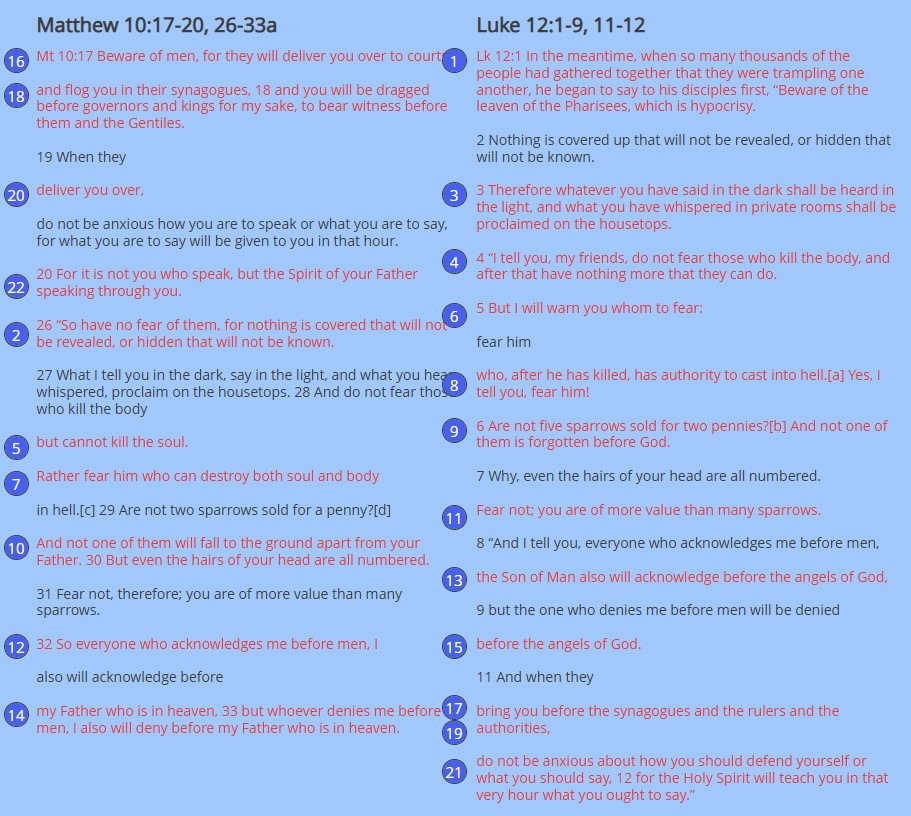
From the above worksheet photo, following the numbers and the text in red, the following narrative is produced.
Lk 12:1 In the meantime, when so many thousands of the people had gathered together that they were trampling one another, he began to say to his disciples first, “Beware of the leaven of the Pharisees, which is hypocrisy. Mt 10:26 So have no fear of them, for nothing is covered that will not be revealed, or hidden that will not be known. Lk 12:3 Therefore whatever you have said in the dark shall be heard in the light, and what you have whispered in private rooms shall be proclaimed on the housetops.”
Lk 12:4 “I tell you, my friends, do not fear those who kill the body, and after that have nothing more that they can do, Mt 10:28 but cannot kill the soul. Lk 12:5 But I will warn you whom to fear. Mt 10:28 Rather fear him who can destroy both soul and body, Lk 12:5 who, after he has killed, has authority to cast into hell. Yes, I tell you, fear him!”
Lk 12:6 “Are not five sparrows sold for two pennies? And not one of them is forgotten before God. Mt 10:29 And not one of them will fall to the ground apart from your father. 30 But even the hairs of your head are all numbered. Lk 12:7 Fear not; you are of more value than many sparrows.”
Mt 10:32 “So everyone who acknowledges me before men, I, Lk 12:8 the Son of Man also will acknowledge before the angels of God, Mt 10:32 [and] my Father who is in heaven, 33 but whoever denies me before men, I also will deny before my Father who is in heaven [and] Lk 12:9 before the angels of God.”
Mt 10:17 “Beware of men, for they will deliver you over to courts Lk 12:11 bring you before the synagogues and the rulers and the authorities, Mt 12:17 and flog you in their synagogues, 18 and you will be dragged before governors and kings for my sake, to bear witness before them and the Gentiles.
Lk 12:11 “[They will] bring you before the synagogues and the rulers and the authorities, Mt 10:19 [and] deliver you over. Lk 12:11 Do not be anxious about how you should defend yourself or what you should say, 12 for the Holy Spirit will teach you in that very hour what you ought to say. Mt 10:20 For it is not you who speak, but the Spirit of your Father speaking through you.”
Bible Lessons for this event:
H467 The Leaven of the Pharisees (Matthew 10:26; Luke 12:1, 3)
H468 Who We Are to Fear (Matthew 10:28; Luke 12:4-5)
H469 The Seriousness of Denying Jesus (Matthew 10:29-30, 32-33; Luke 12:6-7, 9)
H470 Wolves Inflict Pain Need Gospel (Matthew 10:17-20; Luke 12:11-12)
Event Summary:
This event focuses on Jesus’ instructions and encouragement to his disciples as they face persecution and challenges in proclaiming the Gospel. The overarching message emphasizes courage, trust in the Holy Spirit, faithfulness to God, and the importance of public acknowledgment of Jesus.
Key points of this event are:
(1) Expect Persecution but Do Not Fear:
- Jesus told his listeners to “Beware of men, for they will deliver you over to courts and bring you before the synagogues and the rulers and the authorities, and flog you in their synagogues, and you will be dragged before governors and kings for my sake, to bear witness before them and the Gentiles. (See Matthew 10:17-18; Luke 12:11) Jesus said, “I tell you, my friends, do not fear those who kill the body, but cannot kill the soul for after that have nothing more that they can do.” (See Luke 12:4; Matthew 10:28) As they draw closer to the cross, Jesus prepares his disciples for the inevitability of persecution. They will face trials and opposition, but they are to stand firm, knowing that eternal life is secure in God’s hands. Therefore, tear of human threats should not deter faithfulness to God.
(2) Trust the Holy Spirit to Speak Through You:
- Jesus speaks words of encouragement, saying, “Beware of men, for they will deliver you over to court and bring you before the synagogues and the rulers and the authorities and flog you in their synagogues, and you will be dragged before governors and kings for my sake, to bear witness before them and the Gentiles. When they do, do not be anxious about how you should defend yourself or what you should say, for the Holy Spirit will teach you in that very hour what you ought to say. For it is not you who speak, but the Spirit of your Father speaking through you.” (See Matthew 10:19-20; Luke 12:11-12) In times of persecution, like that occurring in countries around the world, believers are not to rely on their own wisdom or eloquence. The Holy Spirit will empower them, providing the words and guidance they need. This is a call to trust in God’s provision and presence.
(3) Fear God, Not Man:
- Jesus tells his disciples not to fear those who can kill the body but cannot kill the soul, but to fear him who can kill and who has the authority to cast into hell (See Matthew 10:27; Luke 12:5). While earthly powers can harm the body, only God has authority over eternal destiny, thus, the fear of God should surpass the fear of humans. Embracing this perspective strengthens one’s courage and prioritizes faithfulness to God.
(4) The Value of Every Believer:
- To show the value of believers, Jesus makes a comparison between sparrows and believers. He says, “Are not two sparrows sold for a penny? And not one of them will fall to the ground apart from your Father. But even the hairs of your head are all numbered. Fear not; you are of more value than many sparrows.” (See Matthew 10:29-30; Luke 12:7) God’s care and sovereignty extend over all creation, including every believer. This reassurance highlights the immense value God places on his people and his intimate knowledge of their lives. Trusting in God’s loving care can remove fear and inspires confidence.
(5) Acknowledge Christ Publicly:
- Everyone who acknowledges me before men, the Son of Man also will acknowledge before the angels of God and my Father who is in heaven, but whoever denies me before men, I also will deny before my Father who is in heaven. (See Matthew 10:32-33; Luke 12:8) As a demonstration of our loyalty and faithfulness, a believer must acknowledge Jesus to others. Those who boldly confess Christ will be affirmed by him before God. Conversely, denial of Jesus results in separation from him.
(6) Warning Against Hypocrisy:
- Jesus tells his disciples to “Beware of the leaven of the Pharisees, which is hypocrisy. So have no fear of them, for nothing is covered that will not be revealed, or hidden that will not be known.” (See Luke 12:1; Matthew 10:26) The hypocrisy that the Pharisees display is to be avoided by those who follow Jesus. Since God will reveal all things, integrity and authenticity are essential in living a life that honors Him.
This event encourages believers to stand firm in faith, trust in the Holy Spirit, and live authentically as witnesses for Christ. Despite persecution and challenges, God’s sovereignty, care, and ultimate authority provide assurance. Publicly acknowledging Jesus is both a privilege and a necessity, reflecting a heart fully devoted to God. This event inspires courage, faithfulness, and reliance on the Holy Spirit in the life of a disciple.
Discussion Questions with Extended Answers:
Matthew 12:22–29; Mark 3:22–27; Luke 11:14–22
1. What miracle did Jesus perform that prompted this discussion with the religious leaders?
Answer:
Jesus cast a demon out of a man who was oppressed by an evil spirit. Matthew records that the man was both blind and mute, while Luke emphasizes that he was unable to speak because of the demon. After Jesus expelled the demon, the man was able to speak and, according to Matthew, see as well. This miracle demonstrated Christ’s authority over the spiritual realm and caused the crowds to marvel. Many began to wonder if Jesus might be the promised Son of David, the Messiah. Rather than rejoicing over the man’s healing, the religious leaders sought to discredit Jesus and prevent people from believing in Him.
2. How did the crowds react to Jesus’ miracle?
Answer:
The crowds were amazed and began asking, “Could this be the Son of David?” This title was a messianic title connected to God’s promise that the Messiah would come through David’s lineage. The miracle caused people to seriously consider Jesus’ identity. They recognized that His works were unlike anything they had seen before. The crowds were moving toward faith, but they had not yet fully committed themselves. Their question reflected growing conviction that Jesus might indeed be the long-awaited Deliverer.
3. What accusation did the scribes and Pharisees make against Jesus?
Answer:
The religious leaders claimed that Jesus cast out demons by the power of Beelzebul, the ruler of demons, whom they associated with Satan. Unable to deny the reality of the miracle, they attacked its source. This accusation was extremely serious because it attributed the work of God’s Spirit to the power of Satan. Their response revealed hardened hearts. Instead of following the evidence before them, they rejected Jesus despite witnessing undeniable demonstrations of divine authority.
4. How did Jesus answer the charge that He was working through Satan’s power?
Answer:
Jesus responded with clear logic. He explained that a kingdom divided against itself cannot stand. If Satan were casting out Satan, then Satan’s kingdom would be destroying itself. Likewise, a divided city or household eventually collapses. Since demons were being expelled, Satan’s influence was being weakened rather than strengthened. Therefore, the accusation made no sense. Jesus showed that their conclusion was irrational and inconsistent with what was actually taking place.
5. What did Jesus mean when He said that a kingdom divided against itself cannot stand?
Answer:
Jesus was teaching a principle about unity and conflict. Every kingdom, nation, family, or organization depends upon some degree of internal cooperation. When members continually fight one another, the entire structure becomes unstable and eventually falls apart. Applying this principle to Satan’s kingdom, Jesus argued that Satan would never intentionally work against his own purposes by empowering someone to destroy his demons. The success of Jesus’ ministry proved that He was not working with Satan but against him.
6. Why did Jesus mention the Jewish exorcists who cast out demons?
Answer:
Jesus asked His critics, “By whom do your sons cast them out?” referring to Jewish exorcists who claimed to expel demons. If the Pharisees accepted those exorcisms as legitimate works of God, why were they condemning Jesus for doing the same thing? Their inconsistent standard exposed their bias. They were not evaluating Jesus fairly; they were rejecting Him because of unbelief. Jesus used their own practices to demonstrate the weakness of their argument.
7. What did Jesus mean when He said, “The kingdom of God has come upon you”?
Answer:
Jesus taught that His power over demons was evidence that God’s kingdom was actively breaking into the world. The arrival of the King meant the arrival of the kingdom. Through His miracles, teachings, and authority over evil spirits, Jesus demonstrated that God was fulfilling His promises. The people were witnessing God’s rule being manifested before their eyes. The kingdom was not merely a future reality; it was present in the ministry of Jesus Himself.
8. What is the meaning of the illustration about the strong man?
Answer:
Jesus compared Satan to a strong man guarding his house and possessions. A strong man can protect what belongs to him as long as no one stronger comes against him. Jesus then described a stronger person who enters, overpowers the strong man, ties him up, and takes his possessions. The strong man represents Satan, while the stronger man represents Jesus. Christ’s ability to cast out demons proved that He had authority over Satan and was actively rescuing people from Satan’s control.
9. How did Jesus’ miracles demonstrate His superiority over Satan?
Answer:
Every time Jesus cast out a demon, healed a person, or delivered someone from spiritual bondage, He demonstrated that Satan’s power was limited before Him. Satan may possess influence in the world, but Jesus possesses absolute authority. The miracles showed that Christ was not merely resisting evil; He was conquering it. His ministry revealed the beginning of Satan’s defeat, a victory that would ultimately be secured through Christ’s death and resurrection.
10. What does this passage teach about spiritual warfare?
Answer:
This passage reveals that spiritual warfare is real and that Satan actively seeks to oppress and deceive people. However, it also teaches that Jesus possesses complete authority over every demonic power. Believers do not need to fear Satan because Christ is stronger. Spiritual victory comes through God’s power rather than human strength. The passage encourages Christians to trust in the Lord’s supremacy and recognize that the kingdom of God is greater than every force of darkness.
11. What does this event reveal about the condition of the Pharisees’ hearts?
Answer:
The Pharisees witnessed undeniable evidence of God’s power, yet they refused to believe. Their problem was not a lack of evidence but a lack of willingness to accept the truth. Pride, jealousy, and spiritual blindness prevented them from recognizing Jesus as the Messiah. Instead of celebrating the deliverance of a suffering man, they sought ways to undermine Christ’s ministry. Their response demonstrates how unbelief can harden a person against even the clearest revelation of God.
12. What should believers learn from this passage today?
Answer:
Believers should recognize Jesus as the victorious King who has authority over every spiritual power. The passage calls Christians to respond to Christ with faith rather than skepticism and hardness of heart. It reminds us that God’s kingdom is advancing through Jesus and that Satan’s power is ultimately limited and temporary. Like the crowds, we must consider who Jesus truly is, but unlike the Pharisees, we should respond with humble faith, worship, and obedience. The passage encourages confidence in Christ’s power, gratitude for His deliverance, and commitment to His kingdom.


Leave a comment