
Trent Goeckner (Had some visitors drop by the other evening! They knew I was there but didn’t seem to mind)
Previous Lesson
Next Lesson
Author: Stephen Weller
2,855 words, 15 minutes read time
How to Pray – “The Lord’s Prayer”
Scripture Reference: Matthew 6:9-15, 7:7-11; Mark 11:25; Luke 11:1-13
Context:
These passages together form one of the clearest and most comprehensive biblical teachings on prayer, revealing not only how believers should pray but also the heart with which they should approach God. In Matthew 6:9-15, Jesus delivers what is commonly called the Lord’s Prayer during the Sermon on the Mount. He contrasts genuine communion with God against the empty repetition and public displays of the religious leaders, teaching that prayer is an intimate conversation with the heavenly Father. The prayer itself establishes God’s holiness, kingdom, and will as the believer’s highest priorities before moving to personal needs such as daily provision, forgiveness, and spiritual protection. Jesus immediately emphasizes that those who have received God’s forgiveness must also extend forgiveness to others, demonstrating that a transformed heart reflects the grace it has received. Later, in Matthew 7:7-11, near the conclusion of the Sermon on the Mount, Jesus encourages persistent and confident prayer through the commands to ask, seek, and knock, assuring His followers that a loving Father delights in giving good gifts to His children. Luke 11:1-13 records a similar teaching, prompted by the disciples’ request, “Lord, teach us to pray.” Luke includes the parable of the friend at midnight, illustrating the value of bold persistence, and concludes by declaring that the Father especially gives the Holy Spirit to those who ask Him. Finally, Mark 11:25 places forgiveness within the setting of faith-filled prayer after Jesus’ cleansing of the temple and His teaching about believing prayer. There Jesus teaches that harboring unforgiveness hinders fellowship with God, reinforcing the truth already established in the Lord’s Prayer. Together, these passages present prayer as a relationship built upon reverence for God, trust in His goodness, dependence upon His provision, perseverance in seeking Him, and a heart that willingly forgives others because it has first experienced the forgiveness of God. They reveal that effective prayer is not merely a religious exercise, but the natural expression of a life surrendered to the Father’s will and shaped by His grace.
Event Narrative:
The narrative for this section was obtained from three similar texts, using the highlighted material shown below. The selection was determined by Jerry Peyton and copyrighted in 2015 by Jerry Peyton and Biblical Studies Press L.L.C.
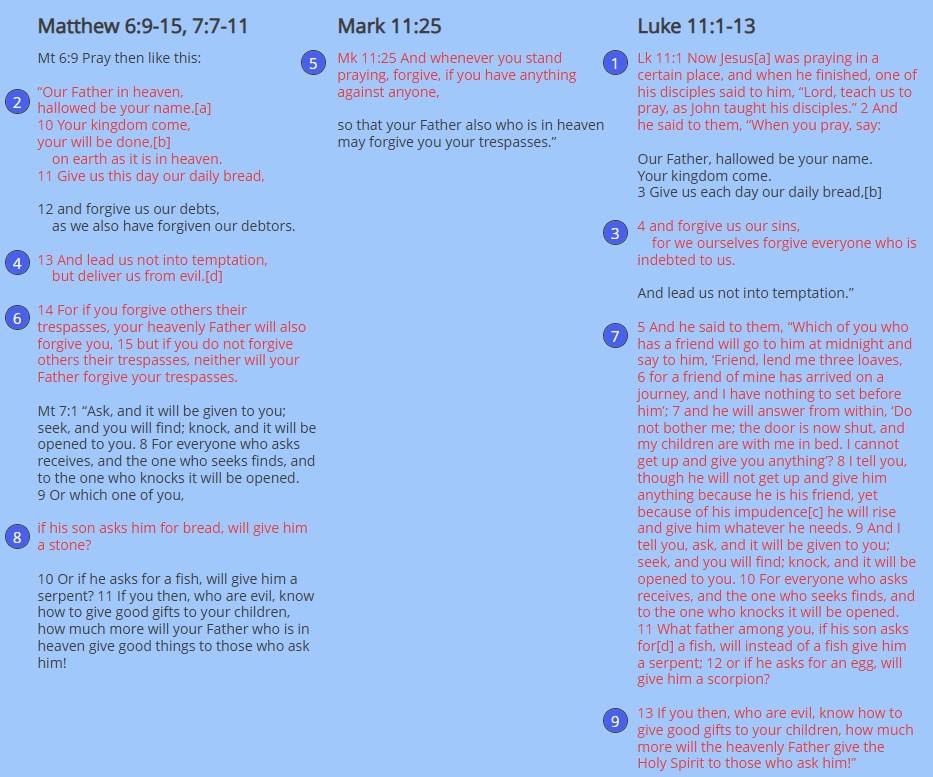
From the above worksheet photo, following the numbers and the text in red, the following narrative is produced.
Lk 11:1 Now Jesus was praying in a certain place, and when he finished, one of his disciples said to him, “Lord, teach us to pray, as John taught his disciples.”
Lk 11:2 And he said to them, “When you pray, say: Mt 6:9 Our Father in heaven, hallowed be your name. 10 Your kingdom come, your will be done, on earth as it is in heaven. 11 Give us this day our daily bread, Lk 11:4 and forgive us our sins, for we ourselves forgive everyone who is indebted to us. Mt 6:13 And lead us not into temptation but deliver us from evil.”
Mk 11:25 “And whenever you stand praying, forgive, if you have anything against anyone. Mt 6:14 For if you forgive others their trespasses, your heavenly Father will also forgive you, 15 but if you do not forgive others their trespasses, neither will your Father forgive your trespasses.”
Lk 11:5 And he said to them, “Which of you who has a friend will go to him at midnight and say to him, ‘Friend, lend me three loaves, 6 for a friend of mine has arrived on a journey, and I have nothing to set before him’; 7 and he will answer from within, ‘Do not bother me; the door is now shut, and my children are with me in bed. I cannot get up and give you anything’? 8 I tell you, though he will not get up and give him anything because he is his friend, yet because of his impudence he will rise and give him whatever he needs.”
9 “And I tell you, ask, and it will be given to you; seek, and you will find; knock, and it will be opened to you. 10 For everyone who asks receives, and the one who seeks finds, and to the one who knocks it will be opened.”
11 “What father among you, if his son asks for a fish, will instead of a fish give him a serpent; 12 or if he asks for an egg, will give him a scorpion? Mt 7:9 If his son asks him for bread, will give him a stone?”
Luke 11:13 “If you then, who are evil, know how to give good gifts to your children, how much more will the heavenly Father give the Holy Spirit to those who ask him!”
Bible Lessons for this event:
H435 “Lord, Teach Us to Pray” (Matthew 6:9-11, 13; Luke 11:1-2, 4)
H436 Our Father in Heaven (Matthew 6:9-11, 13; Luke 11:2, 4)
H437 Hallowed Be Your Name (Matthew 6:9-11, 13; Luke 11:2, 4)
H438 Your Kingdom Come (Matthew 6:9-11, 13; Luke 11:2, 4)
H439 Your Will Be Done (Matthew 6:9-11, 13; Luke 11:2, 4)
H440 Our Daily Bread (Matthew 6:9-11, 13; Luke 11:2, 4)
H441 Forgive Us Our Trespasses (Matthew 6:9-11, 13; Luke 11:2, 4)
H442 Lead Us Not into Temptation (Matthew 6:9-11, 13; Luke 11:2, 4)
H443 The Importance of Forgiveness (Matthew 6:14-15; Mark 11:25)
H444 Because of His Impudence (Luke 11:5-8)
H445 Ask, Seek and Knock (Luke 11:9-10)
H446 A Greater Gift (Matthew 7:9; Luke 11:11-13)
Event Summary:
This event focuses on Jesus’ teaching about prayer, forgiveness, and God’s willingness to respond to His children. Together, they emphasize how to pray, God’s character as a loving Father, the importance of persistence in prayer, and the necessity of forgiving others.
Key points of this event are:
(1) The Lord’s Prayer: How to Pray (Matthew 6:9-15; Luke 11:1-4):
- As this event opens, we find Jesus praying, and when he finished, one of his disciples said to him, “Lord, teach us to pray, as John taught his disciples.” This prompts Jesus to teach his disciples a model prayer, commonly known as the Lord’s Prayer.
- Let’s divide this prayer into five key points:
- Worship God: Mt 6:9 “Our Father in heaven, hallowed be your name” – We are to begin our prayers with reverence and acknowledgment of God’s holiness.
- Submit to God’s Will: 10 “Your kingdom come, your will be done, on earth as it is in heaven” – We are to align with God’s purpose and seek his rule in our lives.
- Depend on God: 11 Give us this day our daily bread” – We are to trust God to meet our daily physical and spiritual needs.
- Seek Forgiveness: Lk 11:4 and forgive us our sins, for we ourselves forgive everyone who is indebted to us. – We are to acknowledge our need for God’s forgiveness and our responsibility to forgive others.
- Ask for protection: Mt 6:13 And lead us not into temptation but deliver us from evil.” – We are to seek God’s guidance and deliverance from sin and evil. This prayer shows us that prayer should be God-centered, humble, and rooted in trust, and it should involve worship, surrender, dependence, repentance, and seeking his protection.
(2) The Importance of Forgiveness (Matthew 6:14-15; Mark 11:25):
- Jesus highlights the connection between receiving forgiveness from God and extending forgiveness to others. Jesus makes this clear in his statement: Mt 6:14 “For if you forgive others their trespasses, your heavenly Father will also forgive you, 15 but if you do not forgive others their trespasses, neither will your Father forgive your trespasses.” Forgiveness is essential for prayer and a right relationship with God, and just as God extends forgiveness to us, we must forgive others.
(3) Persistence and Trust in Prayer (Matthew 7:7-11; Luke 11:5-13):
- In this section of the event, Jesus teaches about the importance of being persistent, bold, and trusting prayer in prayer. When we need something, Jesus tells us to “Ask, and it will be given to you; seek, and you will find; knock, and it will be opened to you. 10 For everyone who asks receives, and the one who seeks finds, and to the one who knocks it will be opened.” To illustrate this, Jesus teaches the parable of the Persistence Friend (See Luke 11:5-8).
The last section of this event is about God’s character as a loving Father. Jesus points out that an earthly father knows how to give good gifts to his children. So, how much more will our Father in heaven give good gifts to his children, and of those gifts the greatest gift is the Holy Spirit. God is a loving Father who responds to his children’s prayers. Believers are encouraged to pray persistently, boldly, and with confidence, trusting in God’s goodness and faithfulness.
In this event, Jesus teaches that prayer is a vital connection to God that requires humility, persistence, trust, and alignment with his will. God, as a loving and gracious Father, hears and answers prayers, providing for our needs and guiding us through his Holy Spirit. Believers are called to forgive others as an expression of the forgiveness they receive from God. Through prayer, Christians are invited into deeper intimacy with God and reliance on his provision, mercy, and guidance.
Discussion Questions with Extended Answers:
Matthew 6:9-15; Matthew 7:7-11; Mark 11:25; Luke 11:1-13
1. Why did Jesus teach His disciples a model prayer instead of simply giving them words to repeat?
Answer:
Jesus was teaching His followers the principles and priorities of true prayer rather than establishing a ritual to be recited mechanically. In Matthew 6, He had just warned against meaningless repetition and empty religious displays (Matthew 6:5-8). The Lord’s Prayer provides a pattern that begins with worship, moves to submission to God’s will, expresses dependence upon God for daily needs, seeks forgiveness, and asks for spiritual protection.
This model reveals that prayer is fundamentally about a relationship with the Father. Believers approach God with reverence (“Our Father in heaven”), humility (“Your will be done”), trust (“Give us this day our daily bread”), repentance (“Forgive us our debts”), and dependence (“Deliver us from evil”). Jesus was showing that prayer is not about impressing others but about genuine fellowship with God.
2. What is the significance of addressing God as “Our Father in heaven”?
Answer:
The title “Our Father” emphasizes both intimacy and authority. Through faith, believers are welcomed into God’s family and may approach Him with the confidence of beloved children. Unlike the distant and impersonal gods of many ancient religions, the God of Scripture invites His people into a close relationship.
The phrase “in heaven” balances this intimacy with reverence. God is not merely a human father; He is the sovereign Creator who reigns over all things. Thus, prayer combines loving trust with holy respect. Jesus teaches that we approach God neither with fear that He is unwilling to hear nor with casual irreverence that forgets His majesty.
3. What does it mean to pray, “Your kingdom come, Your will be done”?
Answer:
This petition expresses a desire for God’s rule to be fully established in the world and in the believer’s own heart. It recognizes that God’s purposes are perfect and that His plans are greater than our own.
Praying for God’s kingdom means longing for the spread of the gospel, the growth of righteousness, and the future return of Christ when His kingdom will be established in fullness. Asking for God’s will to be done is an act of surrender, placing personal desires beneath God’s wisdom. Jesus Himself modeled this attitude in Gethsemane when He prayed, “Not as I will, but as You will” (Matthew 26:39).
4. Why does Jesus include a request for “daily bread”?
Answer:
The request for daily bread reminds believers that every physical need ultimately comes from God. Bread represents the necessities of life—food, shelter, health, work, and provision.
The word “daily” teaches continual dependence rather than self-sufficiency. Just as God provided manna one day at a time for Israel in the wilderness, believers are to trust Him for today’s needs instead of being consumed by anxiety about tomorrow. This request cultivates gratitude, humility, and faith in God’s ongoing care.
5. Why is forgiveness such an important part of prayer?
Answer:
In Matthew 6:12 and Mark 11:25, Jesus connects receiving forgiveness from God with extending forgiveness to others. This does not mean that human forgiveness earns salvation, but that a forgiven heart naturally becomes a forgiving heart.
Holding onto bitterness creates a barrier in one’s fellowship with God. A believer who understands the enormous debt Christ has forgiven should be willing to release the smaller debts owed by others. Forgiveness reflects God’s own character and demonstrates that His grace has truly transformed the heart.
6. What does Jesus mean by “lead us not into temptation, but deliver us from evil”?
Answer:
God does not tempt people to sin (James 1:13), but this prayer asks God to guide believers away from situations where they may be overcome by temptation and to protect them from the power of Satan and evil influences.
The request acknowledges human weakness. Believers recognize that spiritual victory depends not merely upon personal strength but upon God’s preserving grace. This petition encourages vigilance, humility, and reliance upon God’s protection in the daily spiritual battle.
7. What does Jesus teach in Matthew 7:7-11 by saying, “Ask…seek…knock”?
Answer:
The three commands illustrate increasing intensity and persistence in prayer. Asking implies presenting requests to God. Seeking involves actively pursuing His will and presence. Knocking pictures perseverance, continuing to pray until the door is opened.
Jesus assures His followers that God hears and responds to sincere prayer. The present tense of these verbs suggests ongoing action: “keep asking, keep seeking, keep knocking.” This persistence is not meant to persuade a reluctant God but demonstrates faith and dependence upon Him.
8. Why does Jesus compare God to a loving earthly father?
Answer:
Jesus argues from the lesser to the greater. If sinful human fathers know how to provide good gifts for their children, then the perfectly holy and loving heavenly Father will certainly give what is best to His children.
A good father would never replace bread with a stone or a fish with a snake. Likewise, God does not deceive or harm those who trust Him. Even when His answers differ from our expectations, they are always given with perfect wisdom and love for our ultimate good.
9. What lesson does Jesus teach through the parable of the friend at midnight in Luke 11:5-8?
Answer:
The parable emphasizes persistence in prayer. The man receives help not because of friendship alone but because of his bold and continual knocking. Jesus uses this example to encourage believers not to become discouraged when answers seem delayed.
The point is not that God is reluctant like the sleeping neighbor. Rather, if persistence can move an imperfect human being, how much more will a loving Father hear the prayers of His children. God welcomes persistent faith because it expresses trust in His goodness and timing.
10. According to Luke 11:13, what is the greatest gift the Father gives?
Answer:
Jesus concludes by saying that the Father gives “the Holy Spirit to those who ask Him.” While God certainly provides material blessings, the greatest gift He offers is His own presence and power through the Holy Spirit.
The Holy Spirit teaches, comforts, convicts, strengthens, and guides believers into truth. This promise shows that prayer is not merely about obtaining things from God but about receiving more of God Himself. The deepest answer to prayer is a closer relationship with the Father through the ministry of the Holy Spirit.
11. How do these passages together present a complete picture of prayer?
Answer:
Together, these passages reveal that prayer is built upon four essential truths:
- God is our loving Father who welcomes His children.
- Prayer requires humility and submission to God’s will.
- Believers should pray persistently and faithfully, trusting God’s timing.
- Forgiveness and fellowship with others are essential for a healthy prayer life.
Jesus presents prayer not as a religious duty but as the daily expression of a living relationship with God. It is worship, dependence, confession, petition, perseverance, and communion with the heavenly Father.
12. What practical application should believers draw from these teachings on prayer?
Answer:
These passages encourage believers to make prayer a constant and confident practice. Christians should approach God with reverence, trust Him for daily needs, seek His will above their own, forgive others freely, and persist in prayer without losing heart.
Most importantly, Jesus teaches that prayer is rooted in the character of God. Because the Father is perfectly good, believers can come before Him with confidence, knowing that He hears, cares, and always gives what is ultimately best for His children. Prayer, therefore, becomes not merely asking for blessings, but growing in fellowship with the God who loves and sustains His people.


Leave a comment