
Terri Waters Photography & Design (Spring in Clay Country Cornwall)
Previous Lesson
Next Lesson
Author: Stephen Weller
2,192 words, 12 minutes read time
Internal Light
Scripture Reference: Matthew 6:22-23; Luke 11:33-36
Context:
These passages occur within Jesus’ broader teaching about the condition of the heart and the spiritual perception of a person. In Matthew, the teaching is found in the midst of the Sermon on the Mount, where Jesus has been contrasting earthly values with heavenly priorities. Just before this section, He warns against storing up treasures on earth and urges His followers to lay up treasures in heaven. Immediately afterward, He teaches that no one can serve two masters, God and money. The illustration of the eye serving as the lamp of the body bridges these teachings by emphasizing that a person’s spiritual vision determines the direction of the entire life. In Luke’s Gospel, the same truth appears after increasing opposition to Jesus and after His discussion concerning signs and spiritual blindness. Jesus compares the reception of divine truth to light entering a house. Just as a lamp is intended to illuminate rather than be hidden, God’s revelation in Christ is meant to enlighten those who are willing to receive it. The “good” or “healthy” eye represents a heart that is sincere, receptive, and focused on God, allowing His truth to fill the whole person with spiritual light. Conversely, the “bad” eye represents a heart clouded by sin, selfish ambition, unbelief, or divided loyalties, causing spiritual darkness even when light is available. Jesus therefore warns His listeners to examine their spiritual condition carefully, because the way they perceive and respond to God’s truth affects every aspect of their lives. The passage is not primarily about physical sight but about spiritual discernment, emphasizing that those who willingly receive God’s light will walk in greater understanding, while those who reject or distort that light will remain in darkness. Through this teaching, Jesus calls His followers to cultivate undivided devotion to God, clear spiritual perception, and a life illuminated by His truth and righteousness.
Event Narrative:
The narrative for this section was obtained from three similar texts, using the highlighted material shown below. The selection was determined by Jerry Peyton and copyrighted in 2015 by Jerry Peyton and Biblical Studies Press L.L.C.
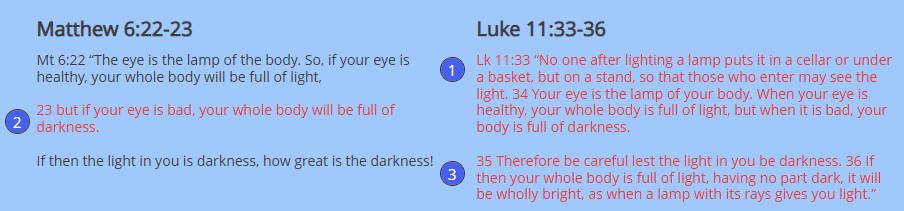
From the above worksheet photo, following the numbers and the text in red, the following narrative is produced.
Lk 11:33 “No one after lighting a lamp puts it in a cellar or under a basket, but on a stand, so that those who enter may see the light. 34 Your eye is the lamp of your body. When your eye is healthy, your whole body is full of light, but when it is bad, your body is full of darkness.”
Mt 6:23 “But if your eye is bad, your whole body will be full of darkness. Lk 11:35 Therefore be careful lest the light in you be darkness. 36 If then your whole body is full of light, having no part dark, it will be wholly bright, as when a lamp with its rays gives you light.”
Bible Lessons for this event:
H458 Light Within (Matthew 6:23; Luke 11:33-36)
Event Summary:
This event focuses on the importance of spiritual perception and the role of the heart in determining a person’s spiritual health and clarity. This event use metaphors of light and the eye to emphasize how one’s inner life influences their actions and relationship with God.
Key points of this event are:
(1) The Eye as the Lamp of the Body:
- When darkness diminishes one’s ability to see, a lamp is lit to remove the darkness. Jesus continues by referring to one’s eye being the lamp of their body. “When your eye is healthy, your whole body is full of light, but when it is bad, your body is full of darkness.” (Luke 11:34) The “eye” symbolizes spiritual perception and focus. A “healthy” or “clear” eye represents a life focused on God, resulting in spiritual clarity, righteousness, and alignment with His will. Conversely, an “unhealthy” or “bad” eye reflects spiritual blindness or a divided focus, leading to moral and spiritual darkness.
(2) Light vs. Darkness Within:
- Jesus issues a warning: “Be careful lest the light in you be darkness. If then your whole body is full of light, having no part dark, it will be wholly bright, as when a lamp with its rays gives you light.” (Luke 11:35-36) Jesus cautions against self-deception; believing one is walking in the light while actually being in darkness. True spiritual light fills the entire life, illuminating every part of a person’s being, just as a lamp brightens a dark room.
(3) The Importance of Inner Focus:
- The eye represents one’s focus and can be either clear or clouded. A clear eye focuses on God and his kingdom, leading to spiritual fulfillment. A clouded or darkened eye is distracted by greed, sin, or worldly concerns, leading to spiritual confusion and separation from God.
(4) The Light of Christ:
- Looking at John 12:46, which is outside this event, Jesus said, “I have come as Light into the world, so that everyone who believes in me will not remain in darkness.” We are born into this world spiritually dead and in darkness. With spiritual birth, the light of Jesus Christ comes into our life, and we no longer walk in darkness.
This event teaches that spiritual clarity and focus are essential for living in God’s light. By keeping our eyes (spiritual perception) healthy and fixed on God, our entire lives will be filled with his truth, goodness, and guidance. These passages encourage believers to avoid spiritual blindness, embrace the light of Christ, and let that light shine in their lives and witness to others.
Discussion Questions with Extended Answers:
Matthew 6:22–23; Luke 11:33–36
1. What does Jesus mean when He says, “The eye is the lamp of the body”?
Answer:
Jesus uses the eye as a metaphor for a person’s spiritual perception and focus. Just as a physical eye allows light to enter the body and enables a person to see clearly, a person’s spiritual “eye” determines how they perceive God, truth, and life. If the eye is healthy, the whole body is filled with light because the person sees things correctly and responds to God’s truth. If the eye is unhealthy, darkness fills the person because their understanding and priorities become distorted.
The eye represents the direction of the heart and mind. A healthy eye is focused on God, His kingdom, and His righteousness. It sees life from God’s perspective. An unhealthy eye is distracted by selfish desires, greed, pride, or worldly pursuits. Such a person may still possess physical sight, but spiritually they are unable to recognize truth clearly. Jesus teaches that what we focus on inwardly shapes the entire course of our lives.
2. What is the difference between a “healthy eye” and an “unhealthy eye”?
Answer:
A healthy eye refers to a sincere, undivided devotion to God. In Matthew 6, this teaching appears immediately after Jesus discusses treasures in heaven and before He teaches about serving God rather than money. Therefore, the healthy eye is connected with generosity, spiritual clarity, and a heart focused on eternal values. A person with a healthy eye sees God’s priorities and desires to live according to them.
An unhealthy eye represents spiritual blindness and divided loyalty. In biblical language, an “evil eye” often referred to envy, greed, or selfishness. Such a person becomes consumed with earthly treasures and loses sight of God’s purposes. The unhealthy eye causes darkness because it prevents a person from seeing truth correctly.
The contrast is not merely between good behavior and bad behavior. It is between spiritual clarity and spiritual blindness, between wholehearted devotion to God and a life controlled by competing desires.
3. Why does Jesus say that darkness within a person is especially dangerous?
Answer:
Jesus declares, “If then the light within you is darkness, how great is that darkness!” (Matthew 6:23). This statement emphasizes the danger of self-deception. Physical darkness is troublesome because it prevents sight, but spiritual darkness is even more serious because it affects a person’s relationship with God.
A person who knows they are lost may seek help, but a person who believes they can see while actually being blind is in a far more dangerous condition. Spiritual darkness can cause someone to believe falsehood is truth, to justify sinful behavior, and to reject God’s guidance. The darkness affects every aspect of life—beliefs, decisions, relationships, and eternal destiny.
Jesus warns His listeners to examine themselves carefully. They must ensure that what they believe to be light is truly God’s truth and not merely human wisdom, tradition, or personal preference.
4. How does the context of Matthew 6 help us understand this teaching?
Answer:
Matthew 6 places this teaching between two important subjects: treasures on earth versus treasures in heaven (Matthew 6:19–21) and serving God versus serving money (Matthew 6:24). This context reveals that Jesus is addressing the issue of spiritual priorities.
The eye serves as a bridge between these teachings. A healthy eye recognizes the value of heavenly treasures and seeks God’s kingdom first. An unhealthy eye becomes captivated by earthly wealth and material gain. The way a person “sees” determines where they store their treasure and whom they ultimately serve.
Jesus is teaching that spiritual vision influences every decision. If our focus is fixed on God’s kingdom, our lives will reflect His light. If our focus is fixed on worldly pursuits, spiritual darkness gradually takes control. The condition of the eye reveals the condition of the heart.
5. Why does Luke include the illustration of a lamp placed on a stand?
Answer:
In Luke 11:33, Jesus reminds His listeners that no one lights a lamp and then hides it. A lamp is placed on a stand so that everyone entering the room can benefit from its light. This illustration emphasizes God’s intention that truth be visible and effective.
God has not hidden His truth. Through Scripture, through Christ, and through the work of the Holy Spirit, He has provided light for humanity. The issue is not whether light is available but whether people are willing to receive it. Jesus is calling His listeners to respond properly to the light God has revealed.
The lamp also points to the believer’s responsibility. Those who receive God’s truth should reflect it openly so that others may benefit from the light they have received.
6. What does Luke mean when he says, “See to it, then, that the light within you is not darkness”?
Answer:
Jesus calls for careful self-examination. It is possible for people to think they possess spiritual understanding while actually being deceived. Religious activity alone does not guarantee spiritual light. Knowledge without obedience can still leave a person in darkness.
This warning urges believers to continually evaluate their hearts, motives, and beliefs according to God’s Word. Are they following God’s truth or merely their own opinions? Are they listening to Christ or allowing worldly influences to shape their thinking?
The command implies personal responsibility. Every person must guard against spiritual blindness by remaining receptive to God’s truth and willing to obey what He reveals. Genuine spiritual light produces humility, repentance, faith, and obedience.
7. What does it mean for the whole body to be “full of light”?
Answer:
In Luke 11:36, Jesus describes a person whose entire being is illuminated by God’s truth. This does not mean perfection but rather a life increasingly transformed by God’s presence and guidance.
When a person receives God’s light, it affects every area of life. Their thoughts become aligned with God’s truth. Their decisions reflect biblical wisdom. Their relationships demonstrate love, forgiveness, and compassion. Their priorities shift from temporary concerns to eternal realities.
The image suggests complete influence. Just as a bright lamp fills a room with light, God’s truth fills the believer’s life with understanding, purpose, and direction. The more a person submits to God’s light, the more clearly they see His will and reflect His character.
8. How can believers maintain a healthy spiritual eye today?
Answer:
Believers maintain a healthy spiritual eye by keeping their focus on Christ and regularly exposing themselves to God’s truth. This includes studying Scripture, praying, worshiping, and seeking the guidance of the Holy Spirit. These practices help believers see life from God’s perspective rather than the world’s.
A healthy eye also requires guarding against influences that distort spiritual vision. Greed, pride, envy, materialism, and sinful desires can cloud judgment and lead to spiritual darkness. Believers must continually evaluate where their attention, affection, and priorities are directed.
Most importantly, a healthy spiritual eye comes from a heart devoted to God. When believers seek first His kingdom and desire His will above all else, His light fills their lives. They gain wisdom, discernment, and the ability to walk faithfully in a dark world while reflecting the light of Christ to others.
Key Truth:
The condition of a person’s spiritual eye determines whether God’s light fills their life or whether darkness takes hold. A heart focused on Christ receives His light, gains spiritual clarity, and reflects His truth to the world.


Leave a comment