
Terri Waters Photography & Design
Previous Lesson
Next Lesson
Author: Stephen Weller
3,159 words, 17 minutes read time
Blaspheming the Holy Spirit
Scripture Reference: Matthew 12:30-37, 43-45; Mark 3:28-30; Luke 11:23-28; 12:10
Context:
These passages occur during a period of increasing opposition to Jesus’ ministry. After healing a demon-possessed man who was blind and mute, the crowds began to wonder if Jesus might truly be the promised Son of David (Matthew 12:22-23). Unable to deny the reality of the miracle, the religious leaders, particularly the scribes and Pharisees, attempted to discredit Jesus by claiming that He cast out demons through the power of Satan rather than by the Spirit of God. Jesus answered by exposing the irrationality of their accusation, explaining that a kingdom divided against itself cannot stand and that His power over demons demonstrated that the kingdom of God had come upon them. He illustrated this by describing Himself as the stronger One who enters the strong man’s house, binds him, and plunders his possessions, symbolizing His authority over Satan and His work of delivering those held captive by evil (Matthew 12:22-29; Mark 3:22-27; Luke 11:14-22).
Against this backdrop, Jesus declared that neutrality toward Him is impossible: “Whoever is not with Me is against Me, and whoever does not gather with Me scatters” (Matthew 12:30; Luke 11:23). His words emphasize that every person must make a decision regarding His identity and mission. The religious leaders had witnessed undeniable evidence of God’s work, yet their hardened hearts led them to deliberately attribute the activity of the Holy Spirit to demonic power. It is in this context that Jesus issued the solemn warning concerning blasphemy against the Holy Spirit (Matthew 12:31-32; Mark 3:28-30; Luke 12:10). Mark explicitly explains the reason for this warning: “because they were saying, ‘He has an unclean spirit’” (Mark 3:30). Their sin was not a careless statement or momentary doubt but a willful, persistent rejection of divine truth despite overwhelming evidence.
Jesus continued by teaching that words reveal the true condition of the heart. Using the illustration of a tree and its fruit, He explained that good words proceed from a good heart, while evil speech flows from an evil heart (Matthew 12:33-37). The Pharisees’ blasphemous accusations exposed the corruption within them, and Jesus warned that people will give an account for every careless word they speak because words are evidence of one’s spiritual condition. Justification or condemnation before God is not based merely on speech itself, but speech reveals whether the heart has responded to God’s truth or rejected it.
Jesus then gave the illustration of an unclean spirit leaving a person and later returning with seven spirits more wicked than itself (Matthew 12:43-45). This parable describes the spiritual danger of outward moral reform without genuine conversion. Israel, and especially its religious leadership, had experienced spiritual awakening through the ministries of John the Baptist and Jesus, yet many refused to receive the Messiah. An empty heart, merely cleansed of external corruption but not filled with the presence and rule of God, remains vulnerable to an even greater spiritual downfall. Jesus concluded by saying, “So shall it also be with this wicked generation,” applying the warning directly to those who had rejected Him.
Luke records an additional moment immediately following these events when a woman in the crowd praised the mother who bore and nursed Jesus. Rather than diminishing Mary, Jesus redirected attention to the greater blessing available to all people: “Blessed rather are those who hear the word of God and keep it” (Luke 11:27-28). True spiritual privilege is not found in physical relationship to Christ but in faithful obedience to God’s revealed truth.
Together, these passages form one of the Bible’s clearest calls to wholehearted commitment to Christ. They warn against the hardening of the heart that knowingly rejects the testimony of the Holy Spirit, teach that our words reveal our inner spiritual condition, and emphasize that true blessing comes through hearing and obeying God’s Word. The passages also highlight the urgency of responding rightly to Jesus, for there can be no neutral ground when confronted with the evidence of God’s kingdom and the person of His Son.
Event Narrative:
The narrative for this section was obtained from three similar texts, using the highlighted material shown below. The selection was determined by Jerry Peyton and copyrighted in 2015 by Jerry Peyton and Biblical Studies Press L.L.C.
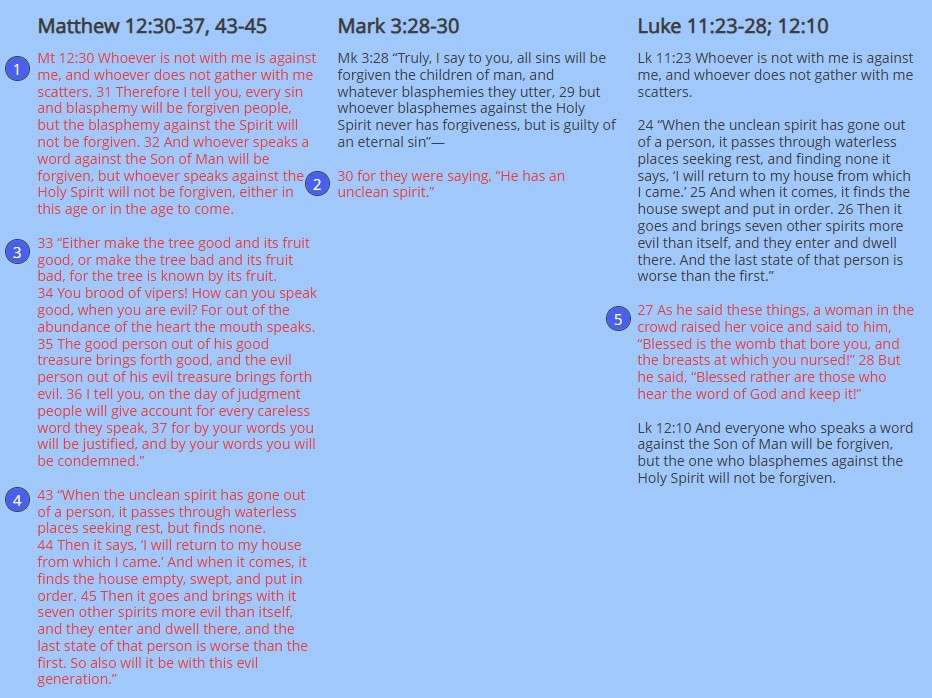
From the above worksheet photo, following the numbers and the text in red, the following narrative is produced.
Mt 12:30 Whoever is not with me is against me, and whoever does not gather with me scatters. 31 Therefore I tell you, every sin and blasphemy will be forgiven people, but the blasphemy against the Spirit will not be forgiven. 32 And whoever speaks a word against the Son of Man will be forgiven, but whoever speaks against the Holy Spirit will not be forgiven, either in this age or in the age to come, Mk 3:30 for they were saying, “He has an unclean spirit.”
Mt 12:33 “Either make the tree good and its fruit good, or make the tree bad and its fruit bad, for the tree is known by its fruit. 34 You brood of vipers! How can you speak good, when you are evil? For out of the abundance of the heart the mouth speaks. 35 The good person out of his good treasure brings forth good, and the evil person out of his evil treasure brings forth evil. 36 I tell you, on the day of judgment people will give account for every careless word they speak, 37 for by your words you will be justified, and by your words you will be condemned.”
Mt 12:43 “When the unclean spirit has gone out of a person, it passes through waterless places seeking rest but finds none. 44 Then it says, ‘I will return to my house from which I came.’ And when it comes, it finds the house empty, swept, and put in order. 45 Then it goes and brings with it seven other spirits more evil than itself, and they enter and dwell there, and the last state of that person is worse than the first. So also, will it be with this evil generation.”
Lk 11:27 As he said these things, a woman in the crowd raised her voice and said to him, “Blessed is the womb that bore you, and the breasts at which you nursed!” 28 But he said, “Blessed rather are those who hear the word of God and keep it!”
Bible Lessons for this event:
H450 Blasphemy Against the Spirit (Matthew 12:30-32; Mark 3:30)
H451 “You Brood of Vipers!” (Matthew 12:33-37)
H452 Day of Judgment (Matthew 12:36-37)
H453 Careless Words (Matthew 12:36-37)
H454 The Unclean Spirit Left Home (Matthew 12:43-45)
H455 The Unclean Spirit Returns Home (Matthew 12:43-45; Luke 11:27-28)
Event Summary:
This event addresses themes of spiritual allegiance, the power of words, the danger of spiritual complacency, and the unforgivable sin (blasphemy against the Holy Spirit). Jesus emphasizes the importance of choosing God’s kingdom, guarding one’s heart, and being accountable for one’s words and actions.
Key points of this event are:
(1) The Necessity of Choosing Sides:
- This event opens with Jesus saying, “Whoever is not with me is against me, and whoever does not gather with me scatters.” (Matthew 12:30) There is no neutral ground in the spiritual battle between God and Satan. People must actively align themselves with Jesus and his mission. Indifference or inaction is equivalent to opposition.
(2) The Unforgivable Sin: Blasphemy Against the Holy Spirit:
- Jesus continues, saying, “Therefore I tell you, every sin and blasphemy will be forgiven people, but the blasphemy against the Spirit will not be forgiven. And whoever speaks a word against the Son of Man will be forgiven, but whoever speaks against the Holy Spirit will not be forgiven, either in this age or in the age to come, (Matthew 12:31-32) The Pharisees attributed Jesus’ miracles, performed through the Holy Spirit, to Satan. This deliberate rejection of the Spirit’s work is identified as blasphemy against the Holy Spirit. Blasphemy against the Holy Spirit involves a hardened heart that persistently and willfully rejects the Spirit’s work, even when faced with undeniable evidence. Such rejection leaves no room for repentance or forgiveness.
(3) The Power of Words:
- Jesus just referred to the Pharisees as a “brood of vipers” and then follows up, saying, “The good person out of his good treasure brings forth good, and the evil person out of his evil treasure brings forth evil. I tell you, on the day of judgment people will give account for every careless word they speak, for by your words you will be justified, and by your words you will be condemned.” (Matthew 12:35-37). The words a person speaks reflects the condition of their heart. Righteous or evil speech reveals one’s inner spiritual state. People will be held accountable for every careless word they speak, as words have the power to justify or condemn.
(4) The Danger of Spiritual Complacency:
- Jesus now turns his attention to the topic of unclean spirits, saying, “When the unclean spirit has gone out of a person, it passes through waterless places seeking rest but finds none. Then it says, ‘I will return to my house from which I came.’ And when it comes, it finds the house empty, swept, and put in order. Then it goes and brings with it seven other spirits more evil than itself, and they enter and dwell there, and the last state of that person is worse than the first. So also, will it be with this evil generation.” (Matthew 12:43-45) Deliverance from sin or evil must be followed by spiritual renewal and commitment to God. Otherwise, the person remains vulnerable to greater spiritual harm. A “clean but empty house” represents a life unfilled with God’s presence.
(5) True Blessedness:
- This event closes with a woman in the crowd raising her voice and saying to him, “Blessed is the womb that bore you, and the breasts at which you nursed!” But Jesus responded, saying, “Blessed rather are those who hear the word of God and keep it!” True blessedness comes not from external relationships or admiration but from hearing and obeying God’s Word. Obedience to God leads to spiritual fulfillment and alignment with His will.
This event emphasizes the urgency of aligning oneself with God’s kingdom and guarding one’s heart and words. They warn against the dangers of rejecting the Holy Spirit and spiritual complacency while encouraging believers to pursue obedience to God’s Word as the path to true blessedness. The teachings challenge individuals to actively choose Jesus and live a life filled with his presence and guidance.
Discussion Questions with Extended Answers:
Matthew 12:30-37, 43-45; Mark 3:28-30; Luke 11:23-28; 12:10
1. What does Jesus mean when He says, “He who is not with Me is against Me” (Matthew 12:30; Luke 11:23)?
Answer:
Jesus teaches that there is no neutral position regarding Him. Every person either belongs to Christ and participates in His work or stands opposed to Him. In the immediate context, the Pharisees had witnessed Jesus casting out demons through the power of the Holy Spirit, yet they attributed His work to Satan. Their refusal to acknowledge the truth placed them in direct opposition to God.
This statement also emphasizes the urgency of discipleship. Following Jesus is not merely intellectual agreement but active loyalty. Those who gather with Christ participate in God’s kingdom, while those who reject Him contribute to spiritual division and loss. Jesus demands a wholehearted commitment because He alone is the source of salvation.
2. Why did the Pharisees claim that Jesus cast out demons by the power of Beelzebul?
Answer:
The religious leaders could not deny the reality of Jesus’ miracles, because they were witnessed publicly and repeatedly. Instead of accepting the obvious conclusion that God was working through Him, they deliberately assigned His works to Satan. Their accusation was not based on ignorance but on hardened unbelief.
Jesus responded by showing the absurdity of their claim. A kingdom divided against itself cannot stand. If Satan were casting out his own demons, he would be destroying his own kingdom. The more logical conclusion was that Jesus was exercising the authority of God’s Spirit, proving that the kingdom of God had come among them.
Their accusation revealed hearts that were resistant to truth despite overwhelming evidence.
3. What is the “blasphemy against the Holy Spirit” mentioned in Matthew 12:31-32, Mark 3:28-30, and Luke 12:10?
Answer:
Blasphemy against the Holy Spirit is the deliberate and persistent rejection of the Holy Spirit’s testimony concerning Jesus Christ, especially by knowingly attributing God’s work to Satan. Mark’s Gospel explains the reason clearly: “because they said, ‘He has an unclean spirit’” (Mark 3:30).
This sin was not a careless word spoken in anger or doubt. The Pharisees had witnessed undeniable evidence of the Spirit’s power and consciously chose to call it demonic. Their hearts had become so hardened that they rejected the very means by which God brings people to repentance.
The unforgivable nature of this sin is not because God is unwilling to forgive, but because the individual completely rejects the Spirit who leads people to forgiveness. As long as someone continues in such hardened rebellion, repentance becomes impossible because they have rejected the only source of salvation.
4. Can a believer today accidentally commit the unforgivable sin?
Answer:
A believer who fears having committed the unforgivable sin has almost certainly not committed it. The very concern and conviction about offending God demonstrate that the Holy Spirit is still working within that person’s heart.
The Pharisees were not troubled by their actions; they were resolute in their rejection of Christ. The unforgivable sin is not a momentary lapse, a blasphemous thought, or a season of doubt. Rather, it is a settled, deliberate, and final rejection of the Holy Spirit’s witness concerning Jesus.
God promises forgiveness for all who genuinely repent and place their faith in Christ. The gospel continually extends mercy to those who turn to Him.
5. Why does Jesus compare people to trees that produce either good or bad fruit (Matthew 12:33-35)?
Answer:
Jesus uses the illustration of a tree and its fruit to teach that outward actions and words reveal the true condition of the heart. Just as an apple tree naturally produces apples, a righteous heart produces righteous speech and conduct.
The Pharisees appeared religious outwardly, but their words exposed their inner corruption. By slandering the work of God, they demonstrated that their hearts were not aligned with Him.
Likewise, believers are called to cultivate hearts transformed by God’s grace. Good fruit does not earn salvation; rather, it is the evidence that God has already changed the heart.
6. What does Jesus mean when He says, “Out of the abundance of the heart the mouth speaks” (Matthew 12:34)?
Answer:
Jesus teaches that our words are windows into our inner spiritual condition. Speech is not random; it flows from the thoughts, beliefs, desires, and attitudes that fill the heart.
A heart filled with faith, gratitude, and love for God will naturally produce words that encourage and glorify Him. Conversely, a heart filled with bitterness, pride, and unbelief will eventually reveal itself through harmful speech.
This principle reminds believers that true spiritual transformation begins within. Christianity is not merely about controlling outward behavior but allowing God to renew the heart through His Spirit.
7. Why does Jesus say that people will give an account for every careless word they speak (Matthew 12:36-37)?
Answer:
Words carry great spiritual significance because they reflect the character and intentions of the speaker. God, who knows every heart, also hears every word. On the Day of Judgment, people will be evaluated not only for their actions but also for the speech that revealed their inner nature.
Jesus is not teaching salvation by works or by perfect speech. Rather, He explains that words serve as evidence of whether a person belongs to God. A transformed heart will increasingly produce truthful, loving, and God-honoring speech.
This warning encourages believers to speak carefully, recognizing that language has the power to bless or to destroy.
8. What is the meaning of the unclean spirit returning to an empty house (Matthew 12:43-45)?
Answer:
Jesus describes an unclean spirit leaving a person and later returning to find the “house” empty, swept, and put in order. The spirit then brings seven others more wicked than itself, leaving the person’s condition worse than before.
This illustration teaches that merely removing evil is not enough. A person must be filled with God’s presence. External moral reform without genuine conversion leaves the heart spiritually vacant and vulnerable.
Jesus applies this specifically to that generation of Israel. Many had experienced spiritual awakening through the ministries of John the Baptist and Jesus, yet many rejected the Messiah. Their refusal to receive Christ left them open to even greater spiritual blindness and judgment.
9. Why does Jesus say that true blessedness belongs to those who hear and obey God’s Word (Luke 11:27-28)?
Answer:
When a woman praised Jesus by honoring His mother, He redirected the focus from physical relationships to spiritual obedience. While Mary was indeed blessed, her greatest blessing came from believing and submitting to God’s will.
Jesus teaches that the highest privilege is not earthly connection to Him but faithful obedience to God’s Word. Anyone who hears, believes, and obeys the gospel becomes part of God’s spiritual family.
This truth emphasizes that salvation and blessing are available to all who respond to God’s revelation with faith.
10. What distinction does Jesus make between speaking against the Son of Man and blaspheming the Holy Spirit (Luke 12:10)?
Answer:
Jesus acknowledges that people may initially misunderstand or even reject Him during His earthly ministry. Many who once opposed Him later came to faith after the resurrection, including some priests and even the Apostle Paul, who had persecuted the church.
However, blaspheming the Holy Spirit involves a much deeper level of rebellion. It is the conscious rejection of the Spirit’s clear testimony about Christ after receiving full knowledge and conviction. The Pharisees had seen undeniable miracles and still declared that God’s Spirit was Satan.
The distinction highlights God’s abundant mercy toward ignorance and weakness while warning against deliberate, hardened unbelief that rejects the very means of grace.
11. What overall lesson connects all of these passages?
Answer:
These passages together present a powerful warning and invitation. Jesus reveals that every person must make a decision concerning Him. Hearts are known by their fruit, words reveal the condition of the soul, and the Holy Spirit bears witness that Jesus is the promised Messiah.
Those who receive Christ experience forgiveness, transformation, and membership in God’s family. Those who continually reject the Spirit’s testimony risk hardening themselves beyond repentance.
The central message is that God’s kingdom has come through Jesus Christ, and the proper response is wholehearted faith, repentance, and obedience to His Word.


Leave a comment